
Category Archives: Game Theory

Noise about Noise: The Good Coach/Bad Coach Fallacy

It is 4th and inches from the 50 yard line. The defense lines up with nine in the box, with a cornerback covering the loan wide receiver and the safety playing a bit closer than usual. The quarterback snaps the ball. The safety breaks in to blitz. The running back executes a play fake. The quarterback bombs it to his wide receiver, who has the safety beat. Touchdown.

“What a great call!” exclaims the color commentator.

Your first reaction might be to agree. After all, the play worked. The safety blitzed, leaving the wide receiver with one-on-one coverage. The quarterback came through, delivering a well-placed ball for a quick score. Credit the offensive coach for the play, and discredit the opposing coach for choosing to blitz.

Well, maybe not.

Let’s investigate how perfect coaches would play this situation. To simplify the situation greatly, suppose the offense can choose whether to call a run or a pass. The defense can choose whether to defend the run or the pass. The defense wants to match, while the offense wants to mismatch. To further simplify things, suppose the defensive benefits for matching are the same whether it is pass/pass or run/run. Likewise, the offensive advantages for mis-matching are the same whether it is pass/run or run/pass.

(These are strong assumptions, but the claims I will make hold for environments with richer play calling and differing benefits for guessing correctly/incorrectly.)

If all that holds, then the game is identical to matching pennies:

In equilibrium, both players flip their coins. Note that as long as the opponent is flipping his coin, the other player earns a fixed amount (zero in this case) regardless of which strategy he selects.

This is a necessary condition to reach equilibrium. If one strategy was even slightly better in expectation given the opposing strategy, then the player would always want to play the superior strategy. For example, if running was even slightly better than passing given the offensive’s expectations about the defense, then the offense must choose to run. But then the defensive coach’s strategy is exploitable. He could switch to defending the run and expect to do better. But the defensive coach is supposed to be superhuman, so he would never do something so foolish.

As it turns out, the only strategies that don’t leave open the possibility of exploitation are the equilibrium strategies. Thus, the superhuman coaches should play according to equilibrium expectations.

Now consider how this situation looks to the observer. We only see outcome of one play. But note that all outcomes occur with positive probability in equilibrium! Sometimes the offense does well. Sometimes the defense does well. But any given outcome is essentially chosen at random.

This makes it impossible to pass judgment in favor or against any coach. Certainly all real world coaches are not perfect. But on any given play, one superhuman coach looks foolish while the other superhuman coach looks great. Consequently, on any given real world play, we cannot tell whether the result was a consequence of terrific coaching on one side (and bad coaching on the other) or just pure randomness.

Thus, we have the good coach/bad coach fallacy. Commentators are quick to praise the genius of the fortunate and lambast the idiocy of the unfortunate, but there simply is no way of knowing what is truly gone on given the information. On-air silence might be awkward, but it beats noise about…noise.
War Exhaustion and the Stability of Arms Treaties

(Paper here.)

Earlier this month, I wrote about Iranian nuclear intransigence. In this post, I want to generalize the argument: war exhaustion sabotages long-term arms treaties.

This is part of my dissertation plan, so some background is in order. My main theoretical chapter shows that if declining states can’t threaten preventive war to stop rising states from proliferating, they can buy them off instead. The idea is that weapons are costly to develop. Rising states don’t have any reason to proliferate if they are already receiving most of the concessions they wish to obtain. Meanwhile, the declining state is happy to offer those concessions to deter the rising state from proliferating.

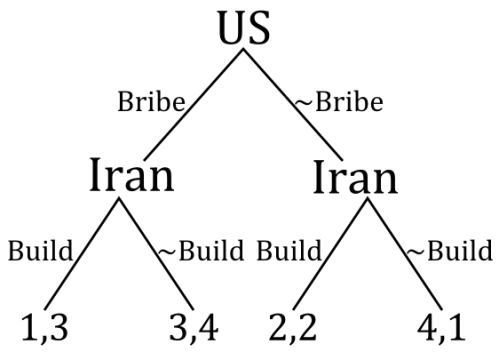
Let’s boil it down to the simplest version of the game possible. The United States has two options: bribe or not bribe. Iran sees the US’s move and decides whether to build a nuclear bomb. American preferences (from top to bottom) are as follows: not bribe/not build, bribe/not build, not bribe/build, bribe/build. Iranian preferences are as follows: bribe/not build, bribe/build, not bribe/build, not bribe/not build.

(I derive these utilities from a more general bargaining setup, so I suggest you look at the paper if you think these seem a little off. I personally wouldn’t blame you, since it seems strange that Iran prefers accepting bribes to taking bribes and proliferating anyway.)

Given that, we have the following game:

b4bgame

By backward induction, Iran builds if the US does not bribe but does not build if the US bribes. In turn, the US bribes to avoid having Iran build.

Great! Iran should not proliferate. But…yeah…that’s not happening at the moment. Why?

One problem is the reason why Iran prefers not building if the United States is bribing. The idea here is that bribes are permanent. By continuing to receive these bribes for the rest of time, Iran sees no need to proliferate since it is already raking in the concessions and nuclear weapons will only waste money.

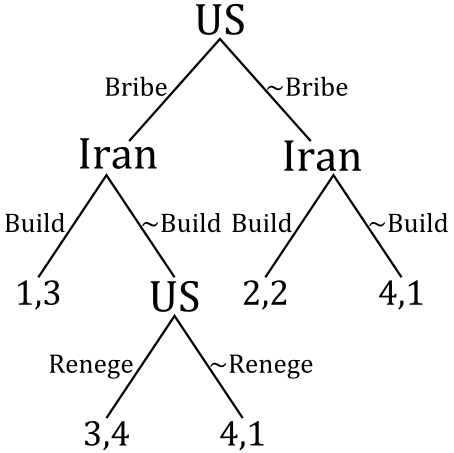
But what if the United States had the power to renege on the concessions? In the future, the US will no longer be suffering from war exhaustion from Afghanistan and Iraq and will force Iran not to proliferate by threat of preventive war. At that point, the US can renege on the bribe without any sort of repercussions.

Again, boiling the argument down to the simplest game possible, we have this:

warexhaustion

Backward induction gives us that the US will renege (why give when you don’t have to?). So Iran builds regardless of whether the US offers a bribe (it’s a ruse!). Proliferation results today because the United States can treat Iran as essentially nuclear incapable in the future. Iran has a window of opportunity and must take it while it can.

This is neat because a commitment problem sabotages negotiations. Recovering from war exhaustion makes the United States stronger in the sense that it will be more willing to fight as time progresses. Yet, this additional strength causes bargaining to fail, since Iran fears that the United States will cut off concessions at some point down the line. More power isn’t always better.

In addition to discussing Iran, the chapter also talks about the Soviet nuclear program circa 1948, which is fascinating. We often take Moscow’s decision to proliferate as a given. Of course the Soviet Union wanted nuclear weapons–there was a cold war going on! But this doesn’t explain why the United States didn’t just buy off the Soviet Union and avoid the mess of the Cold War. Certainly both sides would have been better off without the nuclear arms race.

Again, war exhaustion sabotaged the bargaining process. The United States was not about to invade Russia immediately after World War II ended. Thus, the Soviets had a window of opportunity to proliferate unimpeded and chose to jump through that window. The U.S. was helpless to stop the Soviet Union–we had zero (ZERO!) spies on the ground at the end of WWII and thus had no clue where to begin even if we wanted to prevent. The same causal mechanism led to intransigence in two cases separated by about 60 years.

If this argument sounds interesting to you, I suggest reading my chapter on it. (Apologies that some of the internal links will fail, since the attachment contains only one chapter of a larger project.) I give a much richer version of the model that removes the hokeyness. Feel free to let me know what you think.

Book Review: The Evolution of Cooperation

Book: The Evolution of Cooperation by Robert Axelrod
Five stars out of five.

Suppose two generals each have two choices: attack or defend. The decisions are simultaneous and private. Military strategy favors the offensive, so both really want the other guy to defend while he attacks and really does not want to defend while the other guy attacks. On the other hand, war is extremely bloody. Both generals agree that mutual defense is better than mutual aggression. What should we expect the generals to do?

Intuitively, you might think that mutual defense is a reasonable outcome since peace is an agreeable outcome. However, this fails to appreciate individual incentives. If one general knows the other will play defensively, he should take advantage of his rival’s cooperation and attack. As a result, mutual aggression is the only sustainable outcome. But war is worse for both parties. This is the tragedy known as the prisoner’s dilemma: both parties end up in a mutually despised outcome but cannot commit to the better result due to their selfish individual incentives.

The prisoner’s dilemma has been around since the 1950s. For the next three decades or so, game theorists speculated that repeated interaction could solve the cooperation problem. Perhaps war favors the aggressor, but only a slight degree. If so, the generals could agree to maintain the peace as long as the other guy did. But the moment one slips up, the generals will fight all-out war. The threat of a painful breakdown in peace might incentivize the generals to never start conflict, even if a surprise attack might yield short-term benefits.

However, the cooperative solution remained elusive…until Robert Axelrod’s The Evolution of Cooperation. For a three sentence summary, Axelrod shows that these generals can adopt a “grim trigger” strategy and credibly promise infinite punishment in the future to enforce cooperation in the present. Thus, even bitter rivals can maintain friendly relations over the long term. In essence, we can rationally expect cooperative relationships in even the worst of environments.

Despite how I glossed over all of the intricacies of the repeated prisoner’s dilemma, The Evolution of Cooperation is a must-read for that result alone. But the book is so much more. I first picked it up during my junior year of college. I hadn’t taken a math class in five years, and the grade in that class was a C. Yet, despite the sophistication of the argument, I understood exactly what was going on. Axelrod’s exposition of formal theory in this book is quite simply the best you will ever see.

The fourth chapter is nothing short of awesome. Axelrod takes cooperation to the limit in his study of the “live and let live” trench warfare system during World War I. For a significant chunk of the war, troops spent most of their time deliberately shooting to miss their enemies in the opposing trench. While shooting and killing an enemy soldier provided a marginal gain should a battle take place, said act of shooting risked sparking a larger battle which would cause great causalities on both sides. Thus, for the sake of self-preservation, armies avoided fighting. This culminated in the famous Christmas Truce, in which the troops actually got out of their trenches and began fraternizing with the so-called enemies. (In that vain, you should watch Joyeux Noel if you have not already.)

If there is one issue with the book, it is the emphasis on tit-for-tat. Tit-for-tat is a less aggressive way of responding to your opponent’s aggression than grim trigger; rather than punishing forever, you merely punish at the next available opportunity. Axelrod correctly identifies a bunch of nice properties of tit-for-tat, especially how well it plays nice with others. However, as every modern game theorist knows, tit-for-tat is not subgame perfect and thus is extremely questionable on theoretical grounds. Of course, we would not have found out about that had this book not existed, so this just further solidifies how important The Evolution of Cooperation is.

In sum, go out and buy it. The book has applications to game theory, economics, political science, sociology, evolutionary biology, and psychology. If you are reading this blog, you likely have an interest in one or more of those fields, so you should pick it up.

Game Theory 101 MOOC Completed

My Game Theory 101 MOOC (massive open online course) has been completed for Fall 2012. Conveniently, you can watch the entire series below, find the playlist on YouTube, or take the course via Udemy.

The course covers basic complete information game theory and has an accompanying textbook. Enjoy!

P.S. Here’s a (partial) list of the things it covers: prisoner’s dilemma, strict dominance, iterated elimination of strictly dominated strategies, pure strategy Nash equilibrium, best responses, mixed strategy Nash equilibrium, matching pennies, the mixed strategy algorithm, calculating payoffs, battle of the sexes, weak dominance, iterated elimination of weakly dominated strategies, infinitely many equilibria, extensive form games, game trees, backward induction, subgame perfect equilibrium, tying hands, burning bridges, credible commitment, commitment problems, forward induction, knife-edge equilibria, comparative statics, rock paper scissors, symmetric games, zero sum games. Okay, that was a fairly complete list.

Book Review: Bargaining Theory with Applications

Book: Bargaining Theory with Applications by Abhinay Muthoo.
Four stars out of five.

Let me start by start by saying that this book is actually four stars or zero stars, depending on the audience. This is true for most books, though, so I err on the positive side.

Let’s start with the reasons you should not read this book. You might read the title and think “Gee, I have always wanted to learn about bargaining theory” and therefore decide to read the book. Bad move. This book is completely inaccessible. In the introduction, the author says that the reader only needs a decent understanding of subgame perfect equilibrium to get a lot out of it. This is a gross underestimate–you need at least a full year of game theory to get anything substantial out of the book and two years if you really want to understand it. Even then you will probably scratch your head from time to time. (In the conclusion, the author also says the book “has centered on some basic, elementary, models.” I found that quite humorous.)

The phrase “death by notation” comes to mind as you read this. The author says he intends the book for graduate level economists, and it shows. Variables are often defined once and then never interpreted a second time during a proof. You will often find yourself going back to try to figure out what all of the notation means. (This is a problem for just about all game theory texts, though, which is why I stick to mostly English in my textbook.)

The book also lacks adequate illustrations and figures. Game trees and strategic form matrices help readers understand the flow of the interaction. Figures here are rare and are often baffling. Without them, you will be left to look back at the notation, which has its own problems. (Like before, lack of sufficient illustration is a problem for just about all game theory texts.)

On a personal level, the author spent way too much time discussing the Nash bargaining solution. Personally, I find the Nash bargaining solution to be uninteresting except at the very basic level. Your mileage may vary. And, if you are like me, then you can just skip those sections like I did. So I can’t really fault it for this.

Despite all that, you should read this if you are interested in bargaining and have a good understanding of game theory. I don’t know of any books that are more thorough than it. I originally picked it up for some background on my risk aversion and sports contracts paper, and it was extremely useful. The author covers just about every type of bargaining game you will find in the literature with many variations of each model. So if you want to learn about bargaining, you should spend a few hours reading through it.

For practical purposes, chapter four (bargaining with risk of breakdown), chapter seven (bargaining over bargaining), and chapter nine (incomplete information) are the most useful. Four and seven probably have the most interesting application possibilities. I might reread the seventh chapter again at some point and think about how to relate it to international relations. We seem to have a lot of bargaining models in IR without much discussion of why bargaining protocols should take one particular form and not another. Perhaps this will lead to some publishable research.

I leave you with the following takeaway point: if you follow my work, you would probably enjoy reading this book, and it may qualify as required reading for you; if you found this page by randomly searching the internet for reviews of the book, you should think twice.

Park Place Is Worthless: The Game Theory of McDonald’s Monopoly

McDonald’s Monopoly is back. As always, if you collect Park Place and Boardwalk, you win a million dollars. I just got a Park Place. That’s worth about $500,000, right?

Actually, as I show in my book on bargaining, it is worth nothing. Not close to nothing, but absolutely, positively nothing.

It helps to know how McDonald’s structures the game. Despite the apparent value of Park Place, McDonald’s floods the market with Park Place pieces, probably to trick naive players into thinking they are close to riches. I do not have an exact number, but I would imagine there are easily tens of thousands of Park Places floating around. However, they only one or two Boardwalks available. (Again, I do not know the exact number, but it is equal to the number of million dollar prizes McDonald’s want to give out.)

Even with that disparity, you might think Park Place maintains some value. Yet, it is easy to show that this intuition is wrong. Imagine you have a Boardwalk piece and you corral two Park Place holders into a room. (This works if you gathered thousands of them as well, but you only need two of them for this to work.) You tell them that you are looking to buy a Park Place piece. Each of them must write their sell price on a piece of paper. You will complete the transaction at the lowest price. For example, if one person wrote $500,000 and the other wrote $400,000, you would buy it from the second at $400,000.

Assume that sell prices are continuous and weakly positive, and that ties are broken by coin flip. How much should you expect to pay?

The answer is $0.

The proof is extremely simple. It is clear that both bidding $0 is a Nash equilibrium. (Check out my textbook or watch my YouTube videos if you do not know what a Nash equilibrium is.) If either Park Place owner deviates to a positive amount, that deviator would lose, since the other guy is bidding 0. So neither player can profitably deviate. Thus, both bidding 0 is a Nash equilibrium.

What if one bid $x greater than or equal to 0 and the other bid $y > x? Then the person bidding y could profitably deviate to any amount between y and x. He still wins the piece, but he pays less for it. Thus, this is a profitable deviation and bids x and y are not an equilibrium.

The final case is when both players bid the same amount z > 0. In expectation, both earn z/2. Regardless of the tiebreaking mechanism, one player must lose at least half the time. That player can profitably deviate to 3z/8 and win outright. This sell price is larger than the expectation.

This exhausts all possibilities. So both bidding $0 is the unique Nash equilibrium. Despite requiring another piece, your Boardwalk is worth a full million dollars.

What is going wrong for the Park Place holders? Supply simply outstrips demand. Any person with a Park Place but no Boardwalk walks away with nothing, which ultimately drives down the price of Park Place down to nothing as well.

Moral of the story: Don’t get excited if you get a Park Place piece.

Note 1: If money is discrete down to the cent, then the winning bid could be $0 or $0.01. (With the right tie breaker, it could also be $0.02.) Either way, this is not good for owners of Park Place.

Note 2: In practice, we might see Park Place sell for some marginally higher value. That is because it is (slightly) costly for a Boardwalk owner to seek out and solicit bids from more Park Place holders. However, Park Place itself is not creating any value here—it’s purely the transaction cost.

Note 3: An enterprising Park Place owner could purchase all other Park Place pieces and destroy them. This would force the Boardwalk controller to split the million dollars. While that is reasonable to do when there are only two individuals like the example, good luck buying all Park Places in reality. (Transaction costs strike again!)

Dear Iran, Your Threat Is Incredible. Love, America

Apparently “Iran threatens attack” is the top trending search on Yahoo right now. Here’s a news story of what is going on. Apparently some general in the Iranian air force (Amir Ali Hajizadeh) said that if Israel strikes Iran, Iran will retaliate by attacking American bases in the region.

Umm. Okay.

Iran will do no such thing. The American public does not have the will to engage Iran at the moment. If someone will launch a preventive strike on the Iranian nuclear program, it will be Israel, not the United States. (And, as Israeli officials are finally conceding, this is an unlikely outcome.) But do you know what would give the American public the will to fight? I don’t know, how about an attack on American bases? If Iran initiates on the United States, it undoubtedly ends badly for the Iranians. In turn, anyone who has spent two minutes learning backward induction (see video below) knows how preposterous Iran’s original threat is.

This news story reflects a curious and disturbing trend in American news media. Whenever some crazy person from another country says something inflammatory, it gets reported as though it is serious business, even if it is in no way the actual policy of the regime in charge. Then rhetoric explodes for no particular reason.

The only thing Americans should take away from this news story is that Amir Ali Hajizadeh is a complete idiot.

(Of course, we have some silly people in our country who say silly things, and I am sure that the Iranian media also reports them as though they are serious. This goes both ways.)

Gambling and Corruption with Replacement NFL Referees

If you have watched an NFL game over the last six weeks, you doubtlessly know that NFL referees are in a labor dispute, and the NFL is using replacement referees for the time being. USA Today has an interesting story about the incentives these replacement refs face. Specifically, they are more vulnerable to being bought off by illicit gambling manipulation.

Among gamblers, there is obvious demand for referees willing to take bribes to alter the outcome of the game. For example, suppose the Chargers and Falcons are an even line. (All you have to do is pick the winner to win the bet.) A gambling crew could place a large sum of money on the Chargers, say $1,000,000. They could then pay $100,000 to the referee to ensure the calls go the Chargers’ way such that San Diego wins. The gamblers stand to make hundreds of thousands of dollars.

Besides the threat of criminal punishment, referees have incentive to refuse these bribes due to future benefits from continued officiating. Making terrible calls or being getting caught will get you fired, thus denying you the benefits of continued employment. All other things being equal, if you expect the NFL to continue employing you, you are less likely to take the bribe. Regular NFL officials have this type of long time horizon. They may not be completely unbribe-able, but they are darn resistant.

The replacement refs? Not so much. Their time horizon is extremely small. Once the NFL and the referees resolve their labor dispute, the replacement refs will be gone for good. Rather than years, this time horizon is probably better calculated in weeks or months. Taking a $100,000 bribe doesn’t sound so bad when you are very likely to be unemployed by Halloween, especially when you are making at most $3500 a game.

I find this argument is intuitive and compelling. Moreover, it made me rethink the reasonableness of the referees’ previous contract, which paid about $150,000 for roughly fifty days’ work last year. Such a salary seems ridiculously high given the large supply of potential referee labor. However, the NFL needs to keep the actions of the referees in line with the NFL’s wishes. We can’t just ask potential referees how much they need to be paid to not accept bribes, and then employ the cheapest labor. One way to resolve this issue is to promise continued high pay all referees. Put differently, the high salaries bridge the principal-agent problem.

Avatar: Full of Commitment Problems

At the insistence of many of my friends, I started watching Avatar: The Last Airbender (the TV series, not the dreadful film). The show appears to take place on a post-apocalyptic Earth, where humans have been divided into four tribes (fire, water, earth, and air), which can “bend” their particular element as a means of weaponization.

The world is constantly at war. The show’s narration blames this on the disappearance of the disappearance of the Avatar, the traditional peacekeeper and only person capable of wielding all four elements.

However, the lack of the Avatar fails to explain the underlying incentive for war. Today’s pre-apocalyptic world does not have an avatar, and yet most countries most of the time are not at war with most other countries. Moreover, the Avatar theory does not address war’s inefficiency puzzle, i.e. how the costs of fighting imply the existence of negotiated settlements that are mutually preferable to war. Why not reach such an agreement and end the war that has completely devastated the world economy? The Avatar might be sufficient for peace but is by no means necessary.

In contrast, I propose that the underlying cause of war is the presence of rapid, exogenous power shifts. As described in the episode The Library, the fire tribe’s ability to bend fire disappears during a solar eclipse. Likewise, the water tribe’s ability to water bend disappears during a lunar eclipse. These rare events leave their respective tribes temporarily powerless. In turn, that tribe faces a commitment problem. For example, on the eve of a solar eclipse, the fire tribe would much enjoy reaching a peaceful settlement. In fact, they would be willing to promise virtually everything to achieve a resolution, since they will certainly be destroyed if a war is fought on the solar eclipse.

But such an agreement is inherently incredible. Suppose the other tribes accepted the fire tribe’s surrender. The solar eclipse passes uneventfully. Suddenly, the fire tribe has no incentive to abide by the terms of the peace treaty. After all, their power is fully restored, and they no longer face the threat of a solar eclipse. They will therefore demand an equitable share of the world’s bargaining pie.

Now consider the incentives the other tribes face. If they fail to destroy the fire tribe during the solar eclipse, the fire tribe will demand that equitable stake. But the other tribes could destroy the fire tribe during the eclipse and steal their share. That is a tempting proposition. Indeed, the other tribes likely cannot credibly commit to not taking advantage of the fire tribe’s temporary weakness.

Finally, think one further step back, once again from the perspective of the fire tribe. If the fire tribe does not successfully destroy the other tribes before the solar eclipse, they run the risk of being destroyed on that day. From that perspective, it is perfectly understandable why the fire tribe fights.

Thus, there are commitment problems abound in the world of Avatar. The fire tribe cannot credibly commit to remaining enfeebled after the solar eclipse. The other tribes cannot credibly commit to not attack the fire nation during the eclipse. War seems perfectly rational.

Interestingly, one way out of the problem is for the fire and water tribes to agree to protect one another during their eclipses. Given that, neither side has incentive to attack during the eclipse; if that tribe did join the other tribes in an attack, then it would be left without any protection during the next eclipse. (This resembles a trual–a dual with three people.) Yet, in the series, the fire and water tribes appear to be the most bitter enemies.

One wonders if the library contained a copy of Fearon 1995 or In the Shadow of Power. In any case, you can read more about preventive war in the third chapter of The Rationality of War or watch the below video:

New Working Paper: The Invisible Fist

Download the paper here.

Let’s start with a quote from President Obama, circa September 2009:

Iran must comply with U.N. Security Council resolutions…we have offered Iran a clear path toward greater international integration if it lives up to its obligations…but the Iranian government must now demonstrate…its peaceful intentions or be held accountable to…international law.

We’ve been dealing with the Iranian nuclear “crisis” for a while now. As the quote indicates, President Obama’s method of diplomacy is to offer Iran concessions and hope these carrots convince Iran not to build. His opponents have called such a plan naive; after all, why wouldn’t Iran takes those concessions, say thanks, and then build a nuclear weapon anyway? (Of course, his opponents have also suggested that we threaten to invade Iran to convince Iran not to build, even though such a threat is not credible in the least.)

When I first heard this quote, I fell into the opposing group. We don’t have any models that explain this type of bargaining behavior. In crises, fully realized power drives concessions. Yet, here, unrealized power is causing concessions, and Obama hopes that those concessions in turn mean that the power remains unrealized. I set out to develop a model to show that this type of agreement can never withstand the test of time.

I was wrong. The Invisible Fist shows that such agreements can hold up, even if a rising state can freely renege on the offers. Specifically, declining states offer most of what rising states would receive if they ever built the weapons. This is sufficient to buy off the rising states; while the rising states could build and receive more concessions, those additional concessions do not cover the cost of building. Meanwhile, the declining states are happy to engage in such agreements, because they can extract this building cost out of the rising states.

In any case, I think both the model and the paper’s substantive applications are interesting, so it is worth a look. Let me know what you think.

P.S. Slides here. Paper presentation below: