Tag Archives: Political Science

Preemptive War on the Walking Dead

The Walking Dead is cable’s most successful TV show, ever. I’m writing this after “Home,” and I’m going to assume you know what is going on by and large.

Here’s what’s important. As far as we care, there are only two groups of humans left alive. One, the good guys, have fortified themselves inside an abandon jail. The other lives in a walled town called Woodbury. They became aware of each other a few episodes ago, and they have various reasons to dislike each other.

War appears likely and will be devastating to both parties, likely leaving them in a position worse than if they pretended the other simply did not exist. For example, in “Home,” the Woodbury group packs a courier van full of zombies, breaches the jail’s walls, and opens the van for an undead delivery. Now a bunch of flesh-eaters are wandering around the previously secure prison.

Meanwhile, the jail’s de facto leader went on a mysterious shopping spree and came back with a truck full of unknown supplies. I suspect next episode will feature the jail group bombing a hole in Woodbury’s city walls.

All this leads to an important question: why can’t they all just get along? It’s the end of the world for goodness sake!

As someone who studies war, I am sympathetic to the problem. Woodbury and the jail group are capable of imposing great costs on one another merely by allowing zombies to penetrate the other’s camp. The situation seems ripe for a peaceful settlement, since there appear to be agreements both parties prefer to continued conflict.

This is the crux of James Fearon’s Rationalist Explanations for War, one of the most important articles in international relations in the last twenty years. Fearon shows that as long as war is costly and the sides have a rough understanding of how war will play out, then both parties should be willing to sit down at the bargaining table and negotiate a settlement.

However, Fearon notes that first strike advantages kill the attractiveness of such bargains. From the article:

Consider the problem faced by two gunslingers with the following preferences. Each would most prefer to kill the other by stealth, facing no risk of retaliation, but each prefers that both live in peace to a gunfight in which each risks death. There is a bargain here that both sides prefer to “war”…[but] given their preferences, neither person can credibly commit not to defect from the bargain by trying to shoot the other in the back.

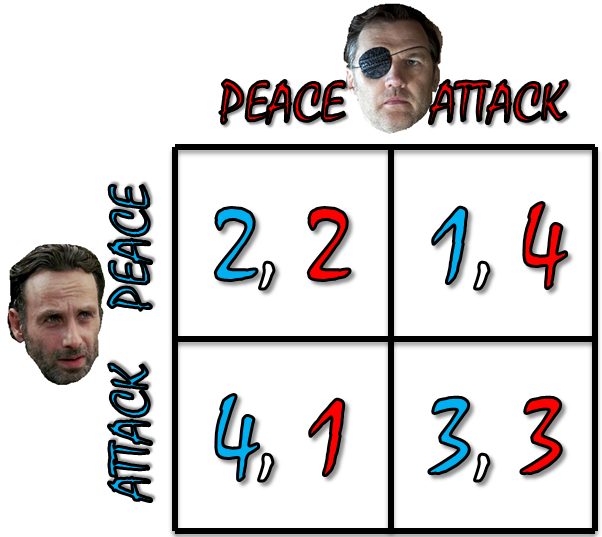
The jail birds and Woodbury are in a similar position:
pd

This is a prisoner’s dilemma.[1] Both parties prefer peace to mutual war. But peace is unsustainable because, given that I believe you are going to act peacefully, I prefer taking advantage of you and attacking. This leads to continued conflict until one side has been destroyed (or, in this case, eaten by zombies), leaving both worse off. We call this preemptive war, as the sides are attempting to preempt the other’s attack.

In the real world, countries have tried to reduce the attractiveness of a first strike by creating demilitarized zones between disputed territory, like the one in Korea. But such buffers require manpower to patrol to verify the other party’s compliance. Unfortunately, the zombie apocalypse has left the world short of people–Woodbury has fewer than a hundred, and the jail birds have fewer than ten. As a result, I believe we be witnessing preemptive war for the rest of this season.

[1] Get it? They live in a jail, and they are in a prisoner’s dilemma![2]

[2] I’m lame.
Does the Vice President’s Vote Matter?

Growing up, I remember my parents telling me about the vice president’s role in the Senate. As president of the Senate, the VP only casts a vote in the event of a 50-50 tie among the senators. Thus, the VP rarely ever casts a vote.

But, as my parents explained, the VP’s vote only matters if there is a tie. If the Senate’s vote was 51-49, or 63-37, or 100-0, the VP’s vote will not change the outcome. So, functionally speaking, the VP has full voting power in the Senate.

Fast forward about fifteen years. Presh Talwalkar had a post on Mind Your Decisions this evening on the very same point. After reading the entry, it hit me there is a major caveat: the filibuster.

For quick review, the Senate only votes on a bill if 60 senators vote to close debate. (If not, someone can “filibuster,” or aimlessly continue creating fake debate, to prevent an actual binding vote.) Thus, despite only needing 51 votes to pass a bill, you really need the tacit approval of 60 senators.

And there’s the rub. The VP does not vote on ending debate. Thus, he is powerless to stop the filibuster. In turn, for the VP’s tie-breaking authority to matter, it must be the case that at least 60 senators tacitly approve of a bill but exactly 50 of them are actually willing to sign off on it.

That’s a big caveat. Essentially, the filibuster nerfs the VP’s voting power.

Butter for Bombs SPSA Presentation

On Thursday, I will be presenting at the 2013 Southern Political Science Association Conference. My paper is entitled “The Invisible Fist: How Potential Power Coerces Concessions.” You can download a copy here. In it, I show that traditional explanations for nuclear proliferation are insufficient, as they do not appreciate bargaining’s role in incentivizing states to not join the nuclear club.

For my presentation, click here.

Fun with Institutions: Airport Subsidy Edition

Going back to Olympic badminton, Olympic swimming, and college football, recall the following:

Law: People will strategize according to the institutional features put in front of them.

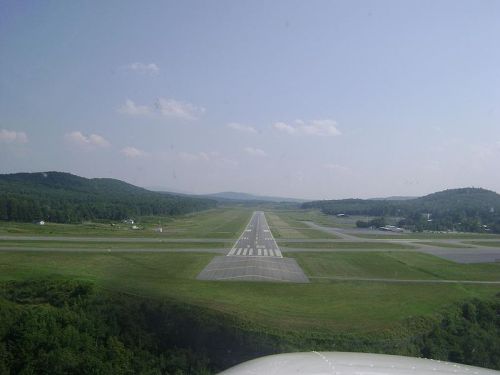
Here’s the beautiful Lebanon Municipal Airport in New Hampshire:

lebanon airport

Lebanon Municipal Airport is one of those tiny airports that services a sparsely populated area. The federal government subsidies these airports so they stay afloat…but only if they have enough customers. In fact, it needs to have 10,000 passengers to qualify for a $1 million grant. Administrators want that grant but are about a thousand short for the year.

Their solution? Sell flights for $12 until they hit the threshold.

Whoever set up the grant system surely did not intend for this to happen. A customer should only count as a customer if he is willing to pay for the good at a price that the business can sustain. But the 10,000 passenger threshold was some arbitrary break point that “separates” worthless airports from airports worth subsidizing. This system is obviously prone to abuse. Credit the Lebanon Municipal Airport administrators for figuring it out.

How do you fix the system? Simple: create a formula to determine the maximum federal grant money as a function of number of passengers per year. An airport that flies 10,000 per year should not be worth $1,000,000 more than an airport that flies 9,999 per year. Offering $100 in subsidies per passenger, for example, would eliminate Lebanon Municipal Airport’s perverse incentives.

War Exhaustion and the Stability of Arms Treaties

(Paper here.)

Earlier this month, I wrote about Iranian nuclear intransigence. In this post, I want to generalize the argument: war exhaustion sabotages long-term arms treaties.

This is part of my dissertation plan, so some background is in order. My main theoretical chapter shows that if declining states can’t threaten preventive war to stop rising states from proliferating, they can buy them off instead. The idea is that weapons are costly to develop. Rising states don’t have any reason to proliferate if they are already receiving most of the concessions they wish to obtain. Meanwhile, the declining state is happy to offer those concessions to deter the rising state from proliferating.

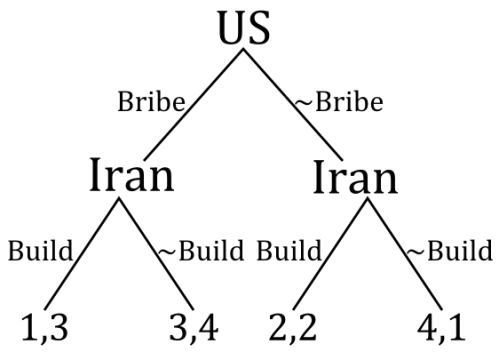
Let’s boil it down to the simplest version of the game possible. The United States has two options: bribe or not bribe. Iran sees the US’s move and decides whether to build a nuclear bomb. American preferences (from top to bottom) are as follows: not bribe/not build, bribe/not build, not bribe/build, bribe/build. Iranian preferences are as follows: bribe/not build, bribe/build, not bribe/build, not bribe/not build.

(I derive these utilities from a more general bargaining setup, so I suggest you look at the paper if you think these seem a little off. I personally wouldn’t blame you, since it seems strange that Iran prefers accepting bribes to taking bribes and proliferating anyway.)

Given that, we have the following game:

b4bgame

By backward induction, Iran builds if the US does not bribe but does not build if the US bribes. In turn, the US bribes to avoid having Iran build.

Great! Iran should not proliferate. But…yeah…that’s not happening at the moment. Why?

One problem is the reason why Iran prefers not building if the United States is bribing. The idea here is that bribes are permanent. By continuing to receive these bribes for the rest of time, Iran sees no need to proliferate since it is already raking in the concessions and nuclear weapons will only waste money.

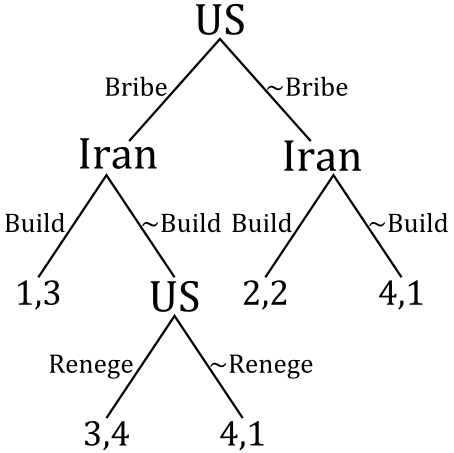
But what if the United States had the power to renege on the concessions? In the future, the US will no longer be suffering from war exhaustion from Afghanistan and Iraq and will force Iran not to proliferate by threat of preventive war. At that point, the US can renege on the bribe without any sort of repercussions.

Again, boiling the argument down to the simplest game possible, we have this:

warexhaustion

Backward induction gives us that the US will renege (why give when you don’t have to?). So Iran builds regardless of whether the US offers a bribe (it’s a ruse!). Proliferation results today because the United States can treat Iran as essentially nuclear incapable in the future. Iran has a window of opportunity and must take it while it can.

This is neat because a commitment problem sabotages negotiations. Recovering from war exhaustion makes the United States stronger in the sense that it will be more willing to fight as time progresses. Yet, this additional strength causes bargaining to fail, since Iran fears that the United States will cut off concessions at some point down the line. More power isn’t always better.

In addition to discussing Iran, the chapter also talks about the Soviet nuclear program circa 1948, which is fascinating. We often take Moscow’s decision to proliferate as a given. Of course the Soviet Union wanted nuclear weapons–there was a cold war going on! But this doesn’t explain why the United States didn’t just buy off the Soviet Union and avoid the mess of the Cold War. Certainly both sides would have been better off without the nuclear arms race.

Again, war exhaustion sabotaged the bargaining process. The United States was not about to invade Russia immediately after World War II ended. Thus, the Soviets had a window of opportunity to proliferate unimpeded and chose to jump through that window. The U.S. was helpless to stop the Soviet Union–we had zero (ZERO!) spies on the ground at the end of WWII and thus had no clue where to begin even if we wanted to prevent. The same causal mechanism led to intransigence in two cases separated by about 60 years.

If this argument sounds interesting to you, I suggest reading my chapter on it. (Apologies that some of the internal links will fail, since the attachment contains only one chapter of a larger project.) I give a much richer version of the model that removes the hokeyness. Feel free to let me know what you think.

The “You Are Imperfect Ergo You Are Worthless” Fallacy

Here is a generic criticism that has been, is, and will be levied at forecasting models like Fivethirtyeight and Votamatic:

The forecasting models fail to account for x, y, and z. But x, y, and z are fundamentally important! Therefore, we should not use the forecasting models.

Fallacious! I think we can all agree that, for various reasons, being able to predict the outcome of elections is important. We cannot just stop forecasting tomorrow. Given that, the question is a matter of what methodology we use to predict outcomes.

In that light, the above criticism fails to highlight the real question. Rather than asking “are forecasting models perfect?” we should be asking “are forecasting models better than the alternative?” In other words, we should treat what we currently have (talking heads on Fox News, CNN, and MSNBC) as the null hypothesis and the forecasting models as the alternative hypothesis. And that being the case, the forecasting models beat the hell out of political punditry.

Yet, the full criticism we often hear is this:

The forecasting models fail to account for x, y, and z. But x, y, and z are fundamentally important! Therefore, we should not use the forecasting models and instead keep pretending my inane rants actually have meaning.

Of course, the political pundit’s inane rants have absolutely no meaning. The pundit is quick to criticize what he does not like but then gives himself a free pass. However, not only does his punditry fail to account for x, y, and z, it is also completely made up horse manure, often fabricated for the sake of ratings. (Or page views…coughunskewedpollscough…)

Now, we should not take forecasting models completely off the hook. They have problems, and their creators are the first to admit that. But, as with anything else in life, we need to ask ourselves whether this devil is better than the other devil. And personally, I’d rather have Nate Silver’s pitchfork pointed at me than Joe Scarborough’s.

Unskewed Polls Guy Is a Genius

Within a few hours (hopefully), we will know who won Ohio, and this election season will mercifully come to a close. All of the sophisticated forecasters agree: Obama is going to win Ohio and therefore the White House. (See Nate Silver and Drew Linzer.)

However, there is one unsophisticated forecaster who is convinced everyone has it wrong. His name is Unskewed Polls Guy. He is convinced that Romney is going to win. Why? Well, Unskewed Polls Guy’s methodology is that we should take all the state polls and arbitrarily add 5% or so to Romney’s total. Or something. Why? Well…uhh…the polls are skewed toward Obama. Or something. Hence, Unskewed Poll Guy unskews the polls by throwing votes Romney’s way. Or something.

As the last paragraph illustrated, I have absolutely no respect for Unskewed Polls Guy’s methodology. To say he is pulling numbers out of his…ahem…would be gentle. Hell, up until today, he had Oregon as a state Romney could potentially win. Oregon. Oregon? OREGON.

But my post title is not sarcastic: Unskewed Polls Guy is a true genius. Here’s why. First, regardless of the election results tonight, Unskewed Polls Guy is already a winner. His website gets a ton of traffic, half from crazy conservatives who believe math is a false paradigm and think he truly is unskewing polls and half from sane people (both liberal and conservative) who find his lunacy to be highly entertaining. The inaccuracy of his forecasting has brought him a substantial bounty–precisely due to how horrible his forecasting is. Brilliant!

But that’s not the real genius of Unskwewed Polls Guy’s ignorant plot. Suppose the other forecasting models do get it “wrong”–that is, the outcome of the election is far away from the mean prediction. This is well-within the realm of possibility. Silver’s model gives Romney a 9% chance to win. That is substantial, and you generally need 95% confidence to get published in social science. Put differently, social scientists would a Romney victory odd but not altogether shocking.

Of course, if this election cycle has taught us anything, it is that the media has absolutely no clue how the forecasting models work. 24/7 cable news has been embarrassing for a while now, but this has gone to a whole new level. If Romney wins, they will treat Unskewed Polls Guy as a prophetic god. He will be the hottest media commodity for the next two weeks. He will get a book deal. He will make a large sum of money. And why? Because he is a complete idiot, has no clue what he is doing or why he is doing it, and just happened to accidentally hit a miracle. If it has happened with an octopus, the frenzy will certainly happen with a human.

And that’s the real genius. If Obama wins, Unskewed Polls Guy takes home a lot of advertising revenue from the past few weeks, and we all forget about him. If Romney wins, Unskewed Polls Guy hits the jackpot. Consequently, if Unskewed Polls Guy is trolling us all, my hat is off to him. If I had thought about this a year ago, I might have been Unskewed Polls Guy.

Going forward, forecasters have awkward incentives. Fivethirtyeight has pretty much cornered the market. You would think that a forecaster should just maximize his chances of being right. But that pretty much means copying Nate Silver. So, to become famous, you really ought to make ridiculously crazy predictions, hope nature randomly makes you right, and reap the short-term rewards. Long-term, you are screwed. But who cares if you’ve already received your book advance?

Will (Illegal) Immigrants “Cause” Obama to Win Reelection?

A couple weeks ago, I read an interesting article about how illegal immigrants can sway Electoral College votes. As it turns out, the Constitution bases electoral votes off of population counts from the census, which in turn must count all people–citizens, legal immigrants, and illegal immigrants–living in the states. Thus, even though only citizens can vote, states with larger numbers of immigrants receive a disproportionate number of electoral votes.

This has obvious electoral consequences. In particular, California gets hammered. California currently has 55 electoral votes but would drop to 50 if the census only counted citizens. On the whole, traditionally red states tend to gain from the alternative method of counting.

Based on this, the article makes the following causal claim:

If President Obama wins reelection by three or four Electoral College votes next month, the reason may be simple: noncitizens, mostly immigrants, who don’t have the right to vote.

But are immigrants really causing Obama to win reelection? Well, yes, but in a very narrow sense of causation. Presidential campaigns, if nothing else, are extremely strategic. The candidates receive a set of rules and base their strategies off the rules. In such a strategic world, you cannot change the rules and hold strategies as being constant, since the strategies are a function of the rules.

To better understand the relationship, consider the following game. All you have to do is pick A or B. If you pick A, I give you $1. If you pick B, I kill you.

Obviously, you are going to pick A. But that does not mean you prefer A. You just prefer the outcome associated with A. If I were to flip the rules on you and say A leads to your death and B pays you $1, you will suddenly really like B and really hate A.

So now imagine we switched the rules of the election to only grant electoral votes based on citizen population counts. Suddenly, some of Obama’s electoral maps are no longer winning strategies. Will Obama naively continue to pursue those strategies? Certainly not–not anymore than you would continue to select A after I switched A from rewarding $1 to killing you. Obama would spend more time and money in new “must-win” states. Romney would likely follow suit. Obama would probably campaign on different issues. Romney would as well. From here, it is not immediately clear who would win the election, since some red states might switch to blue states due to the new policy offerings and vice versa.

In fact, it is not even clear to me whether Romney would have been nominated or if Obama would have been elected in 2008 under the different set of rules. Indeed, the only clear implication of switching the rules is that both candidates would have selected more conservative policy positions. But this is exactly what you should expect when the median (electoral) voter shifts to the right.

Overall, the original article reflects a common problem with our understanding of causation. James Fearon’s article on counterfactuals is a good reference here. When making a counterfactual argument, his guideline is that a premise A only causes B if in the absence of A we have an absence of B. In other words, when making causal arguments, we must give equal weight to the counterfactual story. What does a world without A look like? If we could still reasonably find that B persists in the absence of A, it is hard to claim that A causes B.

This process isn’t too difficult when players are nonstrategic. But throw in strategic players and you really have to do a lot of work. In fact, game theory has a whole process of calculating such changes called comparative statics. Comparative statics are known for producing brutally counterintuitive results. Below is an example with soccer penalty kicks. Strikers actually aim to their weaker side more often than their stronger side. Weird, right?

Absent learning a lot of game theory and learning how to calculate comparative statics, I suppose the moral of the story is to be very careful when making counterfactual claims and to seriously consider how the entire strategic interaction might change if you alter one of the inputs. Apologies for the somewhat unsatisfying conclusion.

Book Review: Leaders and International Conflict

Book: Leaders and International Conflict by Giacomo Chiozza and Hein Goemans
Five stars out of five.

Disclaimer: I either read this book because it just won the Lepgold Prize or because Goemans will be grading my comprehensive exam in a week.[1] I will let you decide which is true.

Personally, I study unitary actor explanations for war. The unitary actor assumption treats a state as though it were a single entity; there are no presidents, there are no parliaments, there are no people, and there are no revolutionaries. These are clearly strong assumptions, but they are useful and justifiable.[2]

War is quite puzzling from the unitary actor perspective. After all, war is costly to both sides because it destroys stuff. Why can’t we just implement the would-be results of war without actually fighting? In this manner, both states are better off since they get what they would get from fighting but without having to pay those costs. This is war’s inefficiency puzzle.[3]

Chiozza and Goemans start with this puzzle and then break out of the unitary actor framework by looking at leaders’ incentives, which has become a popular trend among recent scholarship. Presidents and dictators control their countries’ armies at least to some degree, but the “costs” they pay for fighting may not be the same as the costs that their citizens pay. We normally think of this as being beneficial to the leaders–citizens do the actual fighting (and dying) while the leaders sit back at home and wait for the favorable results. In contrast, Chiozza and Goemans care about what happens to the leaders after war ends, especially when things go badly. Do they retire? Do they go to prison? Into exile? Die? Presumably, the expected fate of the leader weighs heavily on his decision to fight, which in turn changes our expectation on when wars ought to break out.

Specifically, Chiozza and Goemans identify two new causal mechanisms for variation between war and peace: fighting for survival and peace through instability.[4] Let’s start with fighting for survival. Imagine I am the repressive Dictator of Virgon, and I am expecting to face domestic upheaval in the near future due to a food shortage. If the domestic uprising is successful, I expect to lose my head–I have been a brutal dictator for the last ten years. Thus, I have two choices: sit back and let the revolution happen or start a dispute with neighboring Aerilon. If I start the fight against Aerilon, I can send some of the military leaders most capable of plotting a coup against me to the front lines. If the war goes incredibly wrong and they die, I am little safer because I am short a few more coup plotters. If the war goes well, suddenly I am a military genius and everyone loves me. Or the war causes the citizens to finish their rebellion. In the first two situations, I am much better off because I am alive. In the third situation, I’m dead–but, hey, I was going to die anyway. So what the hell. I might as well fight.

This has the flavor of traditional diversionary war, so it is worth noting their emphasis on the role of truncated punishment in the theory. Imagine instead that I were the President of Canceron. We are a fledgling democracy. My power is somewhat stable but not as firm as the U.S. President’s is. I face plenty of domestic opposition, some from within the government and some from within the military. Suppose I am facing that same food shortage. Again, I can choose to attack Aerilon or not. If I don’t, it is quite likely that one of my political rivals will oust me. But we are a fledgling democracy with some rule of law, so I will go back and live a nice retirement on my ten-acre estate. But fighting is much riskier. Yes, I might be successful and save my presidency. But I could also spark further domestic upheaval from my own military. And if they launch a coup to overthrow me…well, I might just lose my head. So I decide to leave Aerilon be. This is Chiozza and Goemans’ peace through instability mechanism; I avoid wars because I prefer taking a lovely retirement with certainty to a gamble between remaining president and dying.

We can attribute the difference in outcomes due to the truncated punishment. The Dictator of Virgon has nothing to lose. His punishment (dying) can’t get any worse, so he willing to fight the war. The President of Canceron, on the other hand, is not. His possible outcomes is not truncated. Fighting can make things much worse–his outcome can switch from retirement to death. Hence he’s not fighting the war.

That, in a nutshell, is the argument. The authors spend chapters three and four empirically investigating the link between war and war outcomes to leader fate. The empirics are accessible to readers without much statistical background, so that is a huge plus. The fifth chapter then qualitatively looks at leader transition and war in Central America from 1840-1918. They find that their theory explains the outbreak of a good portion–though not all–wars during that period. Credit Chiozza and Goemans for being honest here. A single theory will never explain all wars, since wars happen for a variety of reasons. I too often read material that wants to explain everything, which is laughable. Chiozza and Goemans instead make an honest effort and do not unnecessarily oversell their theory.

Finally, I offer two practical reasons to read the book. First, it is just over 200 pages. The writing is succinct, clear of extraneous information[5], and you can easily read it in half a day.[6] It can also be had on Amazon Kindle for about $15, which is remarkably cheap for an academic book that only came out a year ago. Go check it out.

[1] You may then wonder whether I actually believe this book deserves five stars–after all, if I truly thought this book was terrible, I have incentive to misrepresent. However, rest assured that I think it is good. After all, if it were bad, I could have just written no review. But by writing a review, I face potential audience costs from readers who pick up this book because of me and then think it is terrible. Thus, the audience costs make my signal credible. Game theory at work, qed.

[2] See the following video:

[3] See the following video:

[4] Technically, they split fighting for survival into two categories, but I will gloss over it for the sake of time.

[5] Fine, there is extraneous information, but it is in the form of humorous anecdotes, so that makes it okay.

[6] Unfortunately for Goemans, my comprehensive exam will not be succinct. At all. And my dissertation? Well, let’s not go there…

Dear Iran, Your Threat Is Incredible. Love, America

Apparently “Iran threatens attack” is the top trending search on Yahoo right now. Here’s a news story of what is going on. Apparently some general in the Iranian air force (Amir Ali Hajizadeh) said that if Israel strikes Iran, Iran will retaliate by attacking American bases in the region.

Umm. Okay.

Iran will do no such thing. The American public does not have the will to engage Iran at the moment. If someone will launch a preventive strike on the Iranian nuclear program, it will be Israel, not the United States. (And, as Israeli officials are finally conceding, this is an unlikely outcome.) But do you know what would give the American public the will to fight? I don’t know, how about an attack on American bases? If Iran initiates on the United States, it undoubtedly ends badly for the Iranians. In turn, anyone who has spent two minutes learning backward induction (see video below) knows how preposterous Iran’s original threat is.

This news story reflects a curious and disturbing trend in American news media. Whenever some crazy person from another country says something inflammatory, it gets reported as though it is serious business, even if it is in no way the actual policy of the regime in charge. Then rhetoric explodes for no particular reason.

The only thing Americans should take away from this news story is that Amir Ali Hajizadeh is a complete idiot.

(Of course, we have some silly people in our country who say silly things, and I am sure that the Iranian media also reports them as though they are serious. This goes both ways.)