How I Produce My Videos

Every now and then, someone asks me how I produce my YouTube lectures. Rather than answering each of these questions individually, it’s sensible for me to take a moment, create a single answer, and make it a good one. Hence this post.

There are two overall themes: (1) anyone can do it and (2) it is way easier than you probably imagine.

Video
First off, you need something to record your lectures. I use CamStudio. It’s free, and it’s efficient. You simply highlight the part of the screen you want to capture, hit record, and stop when you are done. It will pick up whatever you do in that region and also grabs the audio from your microphone. It also takes very little time to process the file, which is a plus.

Monitor
Everyone has a monitor, but you need one with great screen resolution for CamStudio to pick up enough to shoot your videos in HD. I have a 23″ LG model. It’s a bit excessive, though–as long as you have a decent external monitor that has 1080p resolution, you’ll be fine.

Slides
I use PowerPoint for the most part since it is straightforward. Every now and then, I switch to Beamer because I need to do fancy things with math or grab something from my various academic writings, but that is rare. I shoot the videos from PowerPoint’s standard editing view rather than from the presentation mode so I can keep track of what will appear on the following slides. However, I make sure to increase the size of the slide as much as possible (and put it in widescreen rather than the ugly 4:3 standard) so I can keep the resolution high.

The slides normally come from lecture material I am presenting in class or have presented in previous semesters. This cuts down heavily on how much time I dedicate to this enterprise.

Microphone
You. Need. A. Nice. Microphone. Don’t believe me? Compare these two videos:

(Also, note the difference between widescreen and 4:3.)

The first one uses a crappy $5 microphone I bought at RadioShack in 2007. The other uses a Yeti Blue microphone. And it is glorious:

yeti

Its $100+ price tag might look shocking, but I haven’t regretted the purchase for a moment. It has two major pluses over the prior RadioShack setup. First, it is amazing at filtering out feedback and background noise. You can basically hear my voice and nothing else, and that was not the case before. Second, you can plug earphones into the microphone to hear yourself as you talk. While it is disconcerting at first, it really helps you understand how the end product is going to sound. In fact, part of the audio improvement between those two videos is because I have developed my “radio voice” over last couple of years. I would not have been able to that without the microphone.

Pop Filter
I don’t have one yet, but I probably should. These help differentiate your B’s from your P’s.

Filming and Editing
From there, I pretty much press record and read what’s in front of me. I have a rough idea where things are going, but normally the lecture you hear is the first one I have completed. (A lot of takes don’t actually make it to completion because I did something stupid along the way.) In the rare instance I combine two separate takes, I use YouTube’s video editor. It’s a simple splice between the two cuts, though it can be tricky to get it so that the flow stays natural.

Conclusion
That’s basically it. Like I said, it isn’t as difficult as it may seem. The delivery takes practice, but presentation practice never hurt someone’s academic career.

Sanctions, Uncertainty, and Consolidation of Power

The imposition of economic sanctions is curious. If sanctions have coercive power, powerful sanctions ought to deter rivals from pursuing objectionable policies. On the other hand, if sanctions will be ineffective in a particular case, would-be imposers ought to give up and not lose out on the gains of trade. Why, then, do we see sanctions at all?

In a new working paper from Brad Smith and myself, we argue that asymmetric information about a leader’s consolidation of power plays a critical role in the coercive process. (Edit: I am happy to report that the paper has officially been accepted International Studies Quarterly!) Sanctions ostensibly turn a subset of the selectorate against the current regime. Whether that subset will be pivotal in sparking regime change is critical to determining the effectiveness of sanctions. Because local leaders know their own political predicaments better than foreign adversaries, would-be imposers sometimes have to guess whether sanctions will be worthwhile or not.

Brad and I analyze such a predicament using a formal model. When the potential imposer is sufficiently certain that the target is robust to sanctions, it backs down so as to avoid the economic damage of ineffective sanctions. In contrast, if the imposer believes that the target is vulnerable, weaker opponents sometimes concede the policy issue and sometimes bluff strength. The imposer then sometimes calls potential bluffs (to stop the weaker types from cheating too much) and sometimes backs down (to avoid sanctions a tougher target).

While the outcomes are vastly different, we find an important result regarding the imposer’s quality of information. As the imposer becomes sufficiently certain that its target is weak or strong, the probability of sanctions imposition goes to 0. This is either because the imposer backs down at the beginning (thinking it is facing a tougher type) or because the weaker types have less incentive to bluff toughness. In turn, sanctions are most likely when the imposer is less confident about his opponent’s consolidation of power. This yields a clear testable hypothesis: we should observe fewer sanctions as quality of information increases.

Of course, information (i.e., quality of intelligence estimates) is very difficult to measure. Fortunately, recent works from Scott Wolford and Toby Rider indicate that leader tenure is a useful proxy. Leaders earlier in their careers represent greater unknowns. Over time, publicly observable actions and intelligence gathering improves intelligence estimates. Thus, we expect the likelihood of sanctions to be decreasing in the length of a target’s tenure.

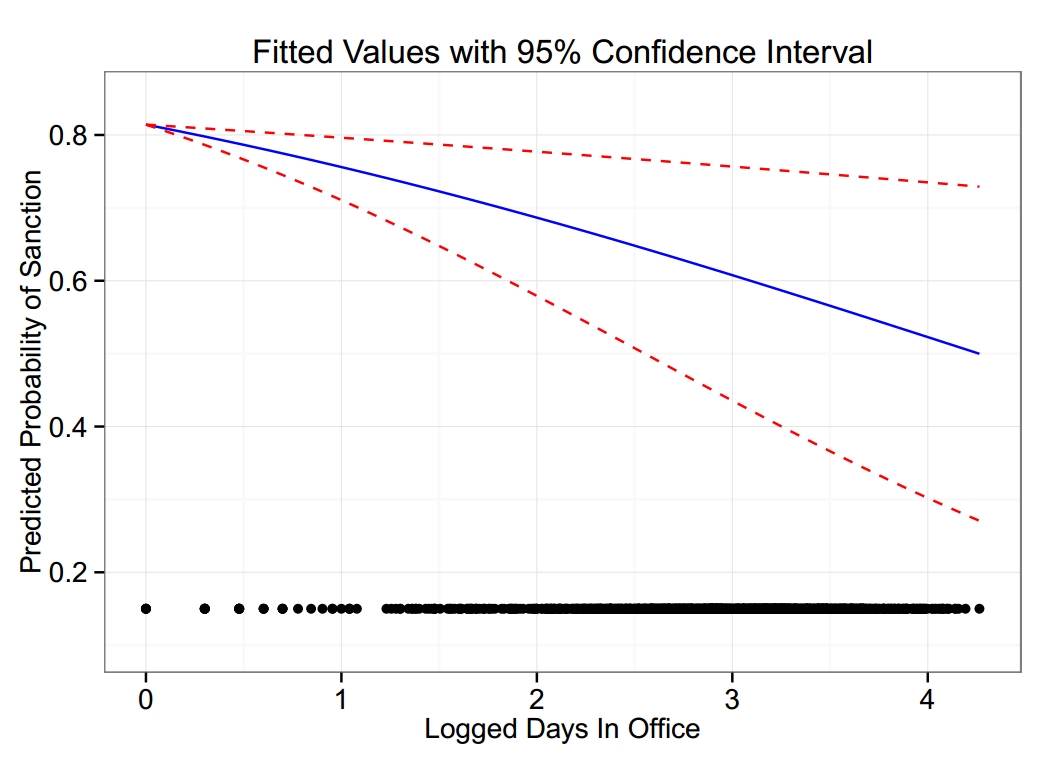
Sure enough, the data support this hypothesis. Moreover, tenure is substantively significant. The plot below shows the predicted probability of sanctions given a crisis as a function of logged leader tenure, holding other observable factors at their medians. A crisis occurring four years into a leader’s term, for example, is 22% less likely to end in sanctions than if the crisis occurred at the beginning.

daysplot

Further, the effect is strongest for autocratic regimes. This fits with the theory. After all, compared to democracies, it is harder to tell who the winning coalition is in an autocracy. Increases in tenure thus generate more information about an autocrat’s vulnerability to sanctions, which in turn more precipitously drops the probability of sanction implementation.

Beyond the theoretical and substantive results, we think a key takeaway is further confirmation of tenure as a proxy for uncertainty. We encourage other scholars to consider using it in empirical models where asymmetric information affects outcomes.

Once again, here’s the paper. The abstract is below.

When do states impose sanctions on their rivals? We develop a formal model of domestic power consolidation, threats, escalation, and imposition of sanctions. With complete information, the target regime’s consolidation of power determines the result—leaders with stable control can weather sanctions and thus deter their imposition, while vulnerable leaders concede the issue. However, when an imposer is uncertain of a foreign leader’s consolidation, vulnerable types have incentive to bluff strength. Foreign powers sometimes respond by imposing sanctions, even though the parties would have resolved the crisis earlier with complete information. We then hypothesize that opponents of newer leaders—particularly in autocracies—are more likely to suffer from this information problem. Employing the Threat and Imposition of Sanctions (TIES) dataset and carefully addressing selection problems common to the sanctions literature, we show that sanctioners are indeed more likely to follow through on threats against such leaders.

New Version of “War Exhaustion and the Credibility of Arms Treaties”

I just updated the manuscript as a standalone paper. Here’s the abstract:

Why do some states agree to arms treaties while others fail to come to terms? I argue that the changing credibility of preventive war is an important determinant of arms treaty stability. If preventive war is never an option, states can reach settlements that both prefer to costly arms construction. However, if preventive war is incredible today but will be credible in the future, a commitment problem results: the state considering investment faces a “window of opportunity” and must build the arms or it will not receive concessions later on. Thus, arms treaties fail under these conditions. I then apply the theoretical findings to the Soviet Union’s decision to build nuclear weapons in 1949. War exhaustion made preventive war incredible for the United States immediately following World War II, but lingering concerns about future preventive action caused Moscow to proliferate.

Download the full paper here.

Memes from My Civil War Class

My class on civil wars is about to wrap up (YouTube playlist here, to be completed later this week). To keep a dark subject matter a little bit lighter, I sprinkled a few /r/AdviceAnimals-style memes throughout my lectures. All of them are below, with their appropriate references.

You’re Gonna Have a Bad Time
1

Despite the explicit warning, I know a handful of people started it the day before it was due. I think a lot of them dropped the class shortly thereafter.

Lazy College Senior
2

Explicit warnings only work when people are there to hear them.

Grinds My Gears and Actual Advice Mallard
3

4

Again, despite the explicit warnings, I had a few midterms say that Rationalist Explanations for War tells us that war is irrational. (Some of these were from otherwise great midterms, so I wonder if I was just being trolled.)

Annoyed Picard
5

In reference to the de-Ba’athification of Iraq.

The Most Interesting Man in the World
6

In reference to the King et al paper on Chinese Internet censorship.

Good Guy Ukraine
7

The timing really couldn’t have been any better.

Lame Pun Raccoon
8

In reference to Viktor Yushchenko and Viktor Yanukovych. This one was my favorite.

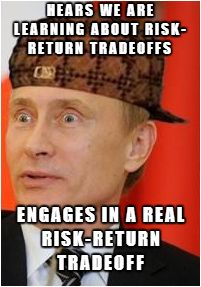
Good Guy Putin/Scumbag Putin
9

10

Again, the timing was impeccable.

Captain Hindsight and Men’s Wearhouse Guy
11

12

In reference to UNSCR 1973, which authorized a no-fly zone over Libya. Russia and China both abstained from the vote despite having veto power and publicly deriding the resolution, perhaps because they were voting strategically.

Lame Pun Raccoon
13

In reference to Bombshell by Mia Bloom. This is my second favorite, and I really wish I could claim that the joke was mine.

Interpret Your Cutpoints

Here is a bad research design I see way too frequently.* The author presents a model. The model shows that if sufficient amounts of x exist, then y follows. The author then provides a case study, showing that x existed and y occurred. Done.

Do you see the problem there? I removed “sufficient” as a qualifier for x from one sentence to the next. Unfortunately, by doing so, I have made the case study worthless. In fact, such case studies often undermine the exact point the author was trying to make with the model!

Let me illustrate my point with the following (intentionally ridiculous) example. Consider the standard bargaining model of war. State A and State B are in negotiations. If bargaining breaks down, A prevails militarily and takes the entire good the parties are bargaining over with probability p_A; B prevails with complementary probability, or 1 – p_A. War is costly, however; states pay respective costs c_A and c_B > 0.

That is the standard model. Now let me spice it up. One thing that the model does not consider is the cost of the stationery**, ink, and paper necessary to sign a peaceful agreement. Let’s call that cost s, and let’s suppose (without loss of generality) that state A necessarily pays the stationery costs.

Can the parties reach a peaceful agreement? Well, let x be A’s share of a peaceful settlement. A prefers a settlement if it pays more than war, or x – s > p_A – c_A. We can rewrite this as x > p_A – c_A + s.

Meanwhile, B prefers a settlement if the remainder pays better than war, or 1 – x > 1 – p_A – c_B. This reduces to x < p_A + c_B.

Stringing these inequalities together, mutually preferable peaceful settlements exist if p_A – c_A + s < x < p_A + c_B. In turn, such an x exists if s < c_A + c_B.

Nice! I have found a new rationalist explanation for war! You see, if the costs of stationery exceed the costs of war (or s > c_A + c_B), at least one state would always prefer war to peace. Thus, peace is unsustainable.

Of course, my argument is completely ridiculous–stationery does not cost that much. My theory remains valid, it just lacks empirical plausibility.

And, yet, formal theorists too often fail to substantively interpret their cutpoints in this way. That is, they do not ask if real-life parameters could ever sustain the conditions necessary to lead to the behavior described.

Instead, you will get case studies that look like the following:

I presented a model that shows that the costs of stationery can lead to war. In analyzing the historical record of World War I, it becomes clear that the stationery of the bargained resolution would have been very expensive, as the ball point pen had only been invented 25 years ago and was still prohibitively costly. Thus, World War I started.

Completely ridiculous! And, in fact, the case study demonstrated the opposite of what the author had intended. That is, if you actually analyze the cutpoint, you will see that the cost of stationery was much lower than the costs of war, and thus the cost of stationery (at best) had a negligible causal connection to the conflict.

In sum, please, please interpret your cutpoints. Your model only provides useful insight if its parameters match what occurred in reality. It is not sufficient to say that cost existed; rather, you must show that the cost was sufficiently high (or low) compared to the other parameters of your model.

* This blog post is the result of presentations I observed at ISA and Midwest, though I have seen some published papers like this as well.

** I am resisting the urge to make this an infinite horizon model so I can solve for the stationary MPE of a stationery game.

The Game Theory of MPSA Elevators

TL;DR: The historic Palmer House Hilton elevators are terribly slow because of bad strategic design, not mechanical issues or overcrowding.

Midwest Political Science Association’s annual meeting–the largest gathering of political scientists–takes place at the historic* Palmer House Hilton each year. While the venue is nice, the elevator system is horrible. And with gatherings on the first eight floors, the routine gets old really fast.

Interestingly, though, the delays are not the result of an old elevator system or too many political scientists moving at once.** Rather, the problem is shoddy strategic thinking.

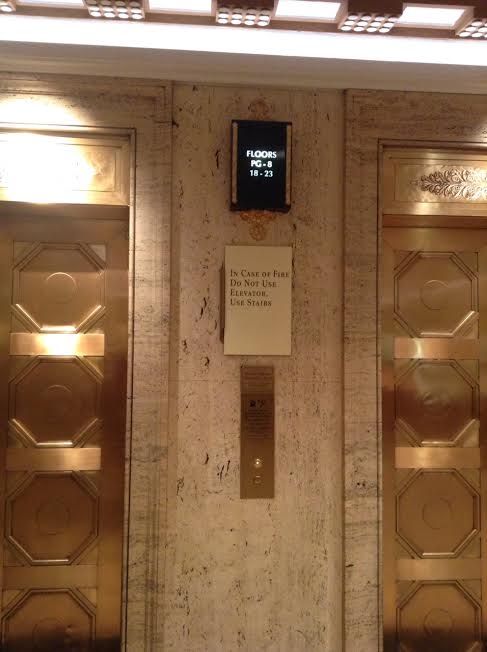
Each elevator bay has three walls. The elevators along each wall have different tasks. Here’s the first one:

ele3

Elevators on this floor go from the ground floor to the 12th floor.

Here’s the second:

ele2

These go from the ground floor to the eighth floor or the 18th floor to the 23rd floor.

And the last wall:

ele1

These go from the ground floor to the eighth floor and the 13th floor to the 17th.

Now suppose you are on the ground level want to go to the 7th floor. What’s the fastest way to get there? For most elevator systems, you press a single button. The system figures out which elevator will most efficiently take you there and dispatches that elevator to the ground level.

But historic Palmer House Hilton’s elevators are not a normal system. Each wall runs independent of one another with three separate buttons to press. So if you really want to get to the seventh floor as fast as possible, you have to press all three–after all, you do not know which of the three systems will most quickly deliver an elevator to your position.

Unfortunately, this has a pernicious effect. Once the first elevator arrives, the call order to the other two systems does not cancel. Thus, they will both (eventually) send an elevator to that floor. Often times, this means an elevator wastes a trip by going to the floor and picking no one up. In turn, people on other floors waiting for that elevator suffer some unnecessary delay.

This is why (1) the elevator system takes forever and (2) you often stop at various floors and pick up no one. We would all be better off if people limited their choice to a single system, but a political scientist running late to his or her next panel does not care about efficiency.

(Let this sink in for a moment. The largest gathering of political scientists has yet to overcome a collective action that plagues it on an every day basis.)

Given the floor restrictions for the elevators, the best solution I can think of would be to install an elevator system where you press the button of the floor you want outside the elevator, and the system chooses which to send from the three walls. This would be mildly inconvenient but would stop all the unnecessary elevator movements.

_____________

*Why is it historic? I have no clue. But everyone says it is.

**The latter undoubtedly contributes to the problem, however.

MPSA 2014 Presentation: War Exhaustion and the Stability of Arms Treaties

If you are interested in nuclear weapons and negotiations with Iran, consider my panel at MPSA. The panel title is “Models of Violence” and will be on Thursday at 8:30 am. Here’s the abstract:

Why are some arms treaties broken while others remain stable over the long term? This chapter argues that the changing credibility of launching preventive war is an important determinant of arms treaty stability. If preventive war is never an option, states can reach settlements that both prefer to costly arms construction. However, if preventive war is incredible today but will be credible in the future, a commitment problem results: the state considering investment must build the arms or it will not receive concessions later on. Thus, arms treaties fail under these conditions. The chapter then applies the theoretical findings to the Soviet Union’s decision to build nuclear weapons in 1949 and Iran’s ongoing nuclear program today. In both instances, war exhaustion made preventive war incredible for the United States, but lingering concerns about future preventive war caused both states to pursue proliferation.

You can download the full paper here.

Is the Ukrainian Nuclear Threat Enough?

Some Ukrainian officials are warning that recent Russian transgressions might force Ukraine to revisit its nuclear weapons program. From a historical perspective, this is understandable. Ukraine signed the Nuclear Nonproliferation Treaty in the mid-1990s in exchange for subsidies and territorial guarantees from the United States and Russia. Russia, seeing a target of opportunity in Crimea, subsequently violated the terms.

Yet these hawkish proclamations are just that: hawkish. They overlook nuclear realities. Ukraine did not pursue nuclear technology following its independence because such a program would have been prohibitively expensive. (And, despite what seems to be conventional wisdom on the subject, Ukraine did not really inherit nuclear weapons.) While Ukraine appears to be in a stronger economic position today, the country is going through so much domestic turmoil at the moment that Kiev’s marginal dollar is probably not best spent embarking on an atomic mission.

But does that mean nuclear weapons are irrelevant to the crisis? Absolutely not. Make no mistake: Ukraine could develop a nuclear weapon given enough time, effort, and angry declarations from the United States and Russia. If Russia made further encroachments on Ukrainian turf–beyond the Crimean target of opportunity–nuclear weapons would stop looking ridiculous and start looking desirable.

However, Putin knows this. He also knows that inducing Ukraine to proliferate is ultimately not in Russia’s best security interests. And he knows that Ukraine would also like to avoid proliferating because of the enormous costs.

These preferences and constraints are common, and I study them formally in my book project on bargaining over proliferation. In such a scenario, states negotiate settlements and avoid nuclear development. Potential nuclear powers do not want to build because they are already receiving a desirable share of the settlement. Rivals do not want to drive a harder bargain because doing so would trigger proliferation; settlement, on the other hand, means they can extract the surplus created by the potential nuclear power avoiding atomic development. Both sides win.

I suspect the Ukraine/Russia crisis will end like this. Russia will not push Ukraine much further.* Ukraine will not develop nuclear weapons, but the threat to do so will give them a better share of the deal.

Interestingly, the potential for nuclear weapons is almost as useful as the nuclear weapons themselves.

*At least until another target of opportunity arises, anyway.

Do Book Sales Determine Number of Book Reviews?

In a word, yes.

That is not what I thought I would say when I first considered writing this blog post. Authors frequently complain that a book of theirs has sold very well and yet does not have very many reviews over on Amazon. And, in fact, that is what inspired me to look into this–my Rationality of War has sold better than I expected it to for the past two years or so, yet it still has zero reviews. Perhaps stranger, Game Theory 101: The Basics is by far my best seller, yet Game Theory 101: The Complete Textbook has the most reviews despite selling only a fraction of the copies.

Aside: I’m being intentionally vague about the exact number of sales any particular book has made because that is a part of my contract with Amazon. The graphs that follow will also be unlabeled. Apologies.

I understand that readers choose to review books for different reasons, so we should not expect reviews to be consistent across genres or even otherwise very similar books. But it seems weird that the difference is so big. Right?

Well, I figured doing some math could help out here. One obstacle to doing a large study on this is having data on a large number of books. Outside of New York Times best sellers, we simply do not know much about sales figures. And looking only at NYT best sellers is problematic since they are all very similar–they have all sold a tremendous number of books.

I can provide a partial solution. I have twelve books up on Amazon and have kept extensive sales records on all of them. While twelve is not a huge number, it will still provide a useful picture on the connection between sales and reviews.

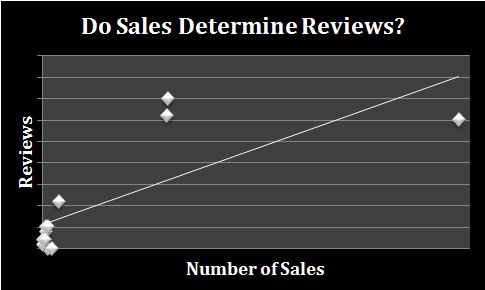
My first thought was to plot the number of sales and the number of reviews each book had. This was not particularly helpful:

notlogged

The diagonal line is the OLS “best-fit” line. Sales do increase the number of reviews, but the graph is not particularly meaningful because of the bunching on the left side of the graph. This is common for data of this type. Book sales have an exponential distribution–many, many books only sell a handful of copies while very few sell a substantial amount. My library also follows this distribution.

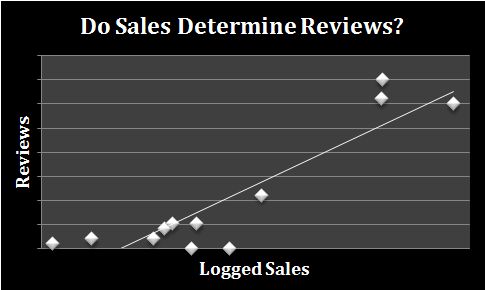
To solve this problem, I logged my sales figures and recreated the same graph:

loggedsales

Ah, much better. We now see a clear trend: more sales lead to more book reviews, though the expectation becomes murkier for the best selling of books.

It shouldn’t be surprising that more sales lead to more books–more people reading increases the number of potential reviewers, after all. However, I was surprised by just how strong the relationship is: the correlation between logged sales and reviews is .896! (Positive correlation ranges between 0 and 1, so it is difficult to get much higher than this.) Even the unlogged data have a strong correlation of .757. The number of sales really is determining the number of reviews.

TL;DR

  1. Book sales are extremely correlated with book reviews.
  2. Variance in the number of reviews increases as books become better sellers.

gt101

ISA 2014 Presentation: War Exhaustion and the Stability of Arms Treaties

If you are interested in nuclear weapons and negotiations with Iran, consider my panel at ISA. The panel title is “TD09: Solving Puzzles with Formal Models: A Panel in Honor of Dina Zinnes” and will be on Thursday at 4 pm. (The lineup is impressive: Dina Zinnes, Kelly Kadera, Mark Crescenzi, Songying Fang, Anne Sartori, and T. Clifton Morgan.) Here’s the abstract:

Why are some arms treaties broken while others remain stable over the long term? This chapter argues that the changing credibility of launching preventive war is an important determinant of arms treaty stability. If preventive war is never an option, states can reach settlements that both prefer to costly arms construction. However, if preventive war is incredible today but will be credible in the future, a commitment problem results: the state considering investment must build the arms or it will not receive concessions later on. Thus, arms treaties fail under these conditions. The chapter then applies the theoretical findings to the Soviet Union’s decision to build nuclear weapons in 1949 and Iran’s ongoing nuclear program today. In both instances, war exhaustion made preventive war incredible for the United States, but lingering concerns about future preventive war caused both states to pursue proliferation.

You can download the full paper here.