Gambling and Corruption with Replacement NFL Referees

If you have watched an NFL game over the last six weeks, you doubtlessly know that NFL referees are in a labor dispute, and the NFL is using replacement referees for the time being. USA Today has an interesting story about the incentives these replacement refs face. Specifically, they are more vulnerable to being bought off by illicit gambling manipulation.

Among gamblers, there is obvious demand for referees willing to take bribes to alter the outcome of the game. For example, suppose the Chargers and Falcons are an even line. (All you have to do is pick the winner to win the bet.) A gambling crew could place a large sum of money on the Chargers, say $1,000,000. They could then pay $100,000 to the referee to ensure the calls go the Chargers’ way such that San Diego wins. The gamblers stand to make hundreds of thousands of dollars.

Besides the threat of criminal punishment, referees have incentive to refuse these bribes due to future benefits from continued officiating. Making terrible calls or being getting caught will get you fired, thus denying you the benefits of continued employment. All other things being equal, if you expect the NFL to continue employing you, you are less likely to take the bribe. Regular NFL officials have this type of long time horizon. They may not be completely unbribe-able, but they are darn resistant.

The replacement refs? Not so much. Their time horizon is extremely small. Once the NFL and the referees resolve their labor dispute, the replacement refs will be gone for good. Rather than years, this time horizon is probably better calculated in weeks or months. Taking a $100,000 bribe doesn’t sound so bad when you are very likely to be unemployed by Halloween, especially when you are making at most $3500 a game.

I find this argument is intuitive and compelling. Moreover, it made me rethink the reasonableness of the referees’ previous contract, which paid about $150,000 for roughly fifty days’ work last year. Such a salary seems ridiculously high given the large supply of potential referee labor. However, the NFL needs to keep the actions of the referees in line with the NFL’s wishes. We can’t just ask potential referees how much they need to be paid to not accept bribes, and then employ the cheapest labor. One way to resolve this issue is to promise continued high pay all referees. Put differently, the high salaries bridge the principal-agent problem.
Avatar: Full of Commitment Problems

At the insistence of many of my friends, I started watching Avatar: The Last Airbender (the TV series, not the dreadful film). The show appears to take place on a post-apocalyptic Earth, where humans have been divided into four tribes (fire, water, earth, and air), which can “bend” their particular element as a means of weaponization.

The world is constantly at war. The show’s narration blames this on the disappearance of the disappearance of the Avatar, the traditional peacekeeper and only person capable of wielding all four elements.

However, the lack of the Avatar fails to explain the underlying incentive for war. Today’s pre-apocalyptic world does not have an avatar, and yet most countries most of the time are not at war with most other countries. Moreover, the Avatar theory does not address war’s inefficiency puzzle, i.e. how the costs of fighting imply the existence of negotiated settlements that are mutually preferable to war. Why not reach such an agreement and end the war that has completely devastated the world economy? The Avatar might be sufficient for peace but is by no means necessary.

In contrast, I propose that the underlying cause of war is the presence of rapid, exogenous power shifts. As described in the episode The Library, the fire tribe’s ability to bend fire disappears during a solar eclipse. Likewise, the water tribe’s ability to water bend disappears during a lunar eclipse. These rare events leave their respective tribes temporarily powerless. In turn, that tribe faces a commitment problem. For example, on the eve of a solar eclipse, the fire tribe would much enjoy reaching a peaceful settlement. In fact, they would be willing to promise virtually everything to achieve a resolution, since they will certainly be destroyed if a war is fought on the solar eclipse.

But such an agreement is inherently incredible. Suppose the other tribes accepted the fire tribe’s surrender. The solar eclipse passes uneventfully. Suddenly, the fire tribe has no incentive to abide by the terms of the peace treaty. After all, their power is fully restored, and they no longer face the threat of a solar eclipse. They will therefore demand an equitable share of the world’s bargaining pie.

Now consider the incentives the other tribes face. If they fail to destroy the fire tribe during the solar eclipse, the fire tribe will demand that equitable stake. But the other tribes could destroy the fire tribe during the eclipse and steal their share. That is a tempting proposition. Indeed, the other tribes likely cannot credibly commit to not taking advantage of the fire tribe’s temporary weakness.

Finally, think one further step back, once again from the perspective of the fire tribe. If the fire tribe does not successfully destroy the other tribes before the solar eclipse, they run the risk of being destroyed on that day. From that perspective, it is perfectly understandable why the fire tribe fights.

Thus, there are commitment problems abound in the world of Avatar. The fire tribe cannot credibly commit to remaining enfeebled after the solar eclipse. The other tribes cannot credibly commit to not attack the fire nation during the eclipse. War seems perfectly rational.

Interestingly, one way out of the problem is for the fire and water tribes to agree to protect one another during their eclipses. Given that, neither side has incentive to attack during the eclipse; if that tribe did join the other tribes in an attack, then it would be left without any protection during the next eclipse. (This resembles a trual–a dual with three people.) Yet, in the series, the fire and water tribes appear to be the most bitter enemies.

One wonders if the library contained a copy of Fearon 1995 or In the Shadow of Power. In any case, you can read more about preventive war in the third chapter of The Rationality of War or watch the below video:

New Working Paper: The Invisible Fist

Download the paper here.

Let’s start with a quote from President Obama, circa September 2009:

Iran must comply with U.N. Security Council resolutions…we have offered Iran a clear path toward greater international integration if it lives up to its obligations…but the Iranian government must now demonstrate…its peaceful intentions or be held accountable to…international law.

We’ve been dealing with the Iranian nuclear “crisis” for a while now. As the quote indicates, President Obama’s method of diplomacy is to offer Iran concessions and hope these carrots convince Iran not to build. His opponents have called such a plan naive; after all, why wouldn’t Iran takes those concessions, say thanks, and then build a nuclear weapon anyway? (Of course, his opponents have also suggested that we threaten to invade Iran to convince Iran not to build, even though such a threat is not credible in the least.)

When I first heard this quote, I fell into the opposing group. We don’t have any models that explain this type of bargaining behavior. In crises, fully realized power drives concessions. Yet, here, unrealized power is causing concessions, and Obama hopes that those concessions in turn mean that the power remains unrealized. I set out to develop a model to show that this type of agreement can never withstand the test of time.

I was wrong. The Invisible Fist shows that such agreements can hold up, even if a rising state can freely renege on the offers. Specifically, declining states offer most of what rising states would receive if they ever built the weapons. This is sufficient to buy off the rising states; while the rising states could build and receive more concessions, those additional concessions do not cover the cost of building. Meanwhile, the declining states are happy to engage in such agreements, because they can extract this building cost out of the rising states.

In any case, I think both the model and the paper’s substantive applications are interesting, so it is worth a look. Let me know what you think.

P.S. Slides here. Paper presentation below:

Unintended Consequences, Pt. 2: College Football Edition

Back during the Olympics, I wrote about badminton players intentionally playing to lose. Despite the absurdity of the situation, the Olympians were merely following one of political science’s most important laws:

Law: People will strategize according to the institutional features put in front of them.

We can now add college football players to the list of people who follow the rule. Over the off-season, the NCAA created a rule which forces a player whose helmet comes off during a play (incidental or otherwise) to sit out the following play. To the surprise of no one, defenders are now taking advantage of it. Here is the new game plan, in three simple steps:

  1. Get the opposing quarterback into a large pile.
  2. Take off his helmet.
  3. Profit.

The rule seems inherently bizarre. It’s understandable to force a player to sit out a play if his helmet explodes off of his head on a major hit; concussions are a major issue in football. But if the helmet just slides off (maliciously or otherwise) away from the action, there doesn’t seem to be much reason to force such a player out of the game temporarily.

How to Make Your eBook Look Real Instantly

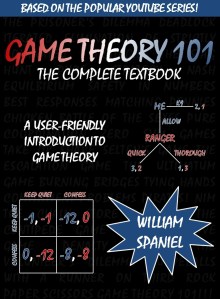
Here’s an annoying problem e-publishers face. I have a book, Game Theory 101: The Complete Textbook. It’s a really awesome book. But it’s also completely digital. As such, I can’t do promotional images of a book. All I have is a two dimensional cover:

I think I have a cool looking cover. But it would be really nice to have a physical book for promotional images.

As luck would have it, I accidentally found a way to accomplish this when I wrote my previous blog post. I wanted to create a promotional image for the book that wasn’t just the cover. After playing around for a while, I eventually got to this:

Looks pretty nice, right? The best part of it is that it is (mostly) a default setting in PowerPoint, so it is extremely easy to replicate on your own. Here’s how to do it for yourself in a few simple steps:

1) Grab the original image of your cover. This process isn’t going to turn a sucky book cover awesome, so I hope you already have a decent one to start with.

2) Open up Microsoft PowerPoint. Paste the image into a blank slide. (I’m using the 2007 edition here, which is still pretty standard. I’m not sure if it works on 2003 or 2010. I suspect these settings did not exist in the 2003 edition. They probably exist in the 2010 edition, but I have no clue if they are still default settings.)

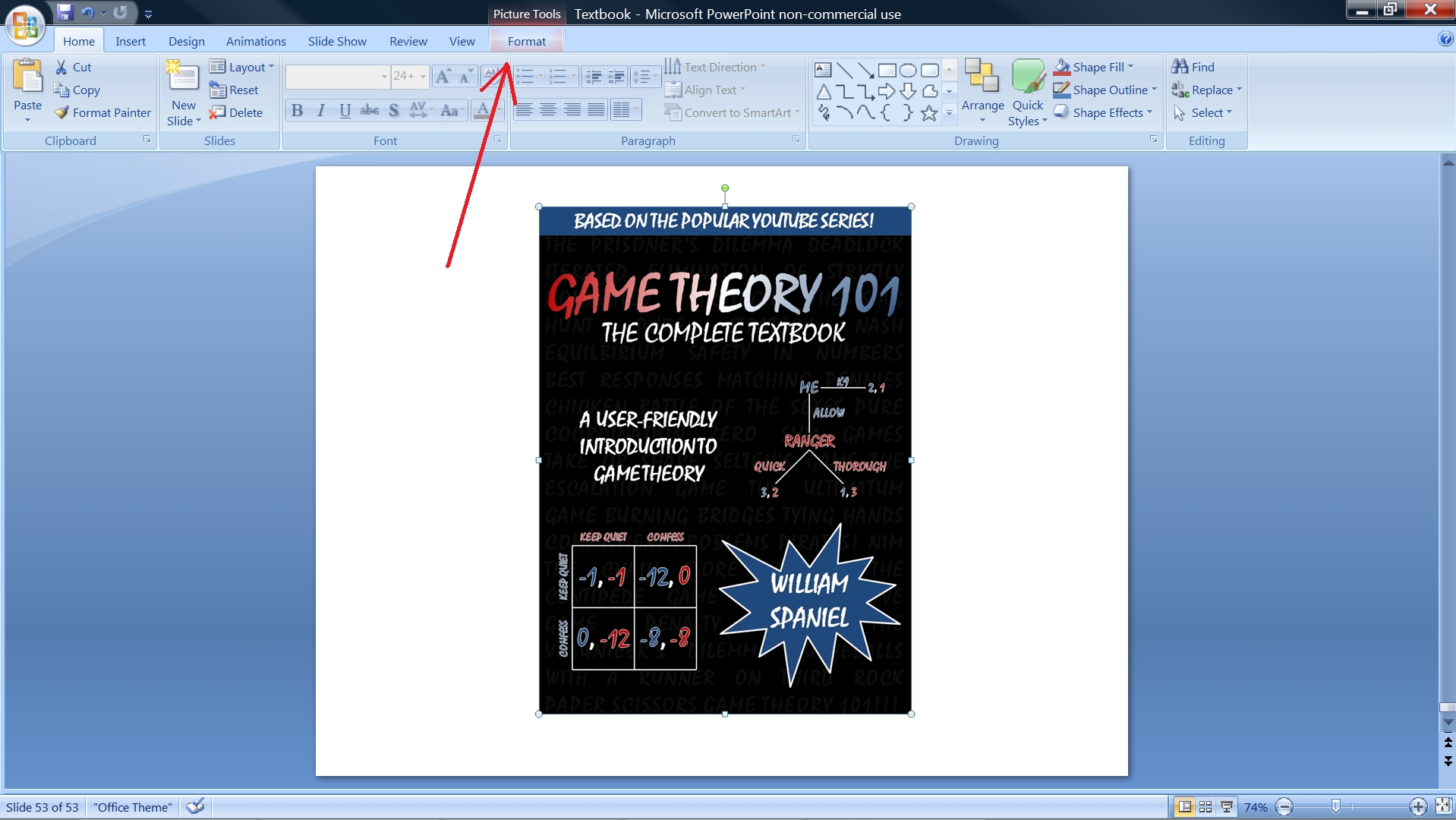
3) Click once on the image. This should make a Format tab appear in the tabs bar. Click on it.

4) Click on Picture Effects, go to Presets, and choose preset number 10 (pictured).

5) You now have an image of your book that looks like it is a physical copy. You can right click to save the picture or just copy and paste it into the image editing program of your choice.

You can also make some further edits to tailor the image to your liking. For example, I made two changes to my final image. To access the options, right click on the image and select Format Picture. I removed the transparency by clicking on 3-D Format, selecting Material, and choosing Warm Matte. Also on the 3-D Format menu, I changed Depth to 15 pt. This makes the book look a little bit thicker.

Even with these additional changes, the entire process takes under a minute. I think the end product looks great, and I hope this you sell a few more copies of your book.

Excerpt from Game Theory 101: The Complete Textbook

With school starting once again, I thought it was time to do some updating to the greater Game Theory 101 enterprise. Here’s the updated version of lesson 1.1 of Game Theory 101: The Complete Textbook. Enjoy.

Course Websites on Udemy

I’ve begun putting full courses on game theory and international relations on Udemy. Udemy creates a nice interface and is much better than YouTube at integrating course work. Check them out:

Game Theory 101 on Udemy

International Relations 101 on Udemy

Content still being loaded up at time of blog entry.

Book Review: Games Prisoners Play

A few weeks ago, a fellow grad student told me about a book that uses game theory to discuss prison life. That book ended up being Games Prisoners Play: The Tragicomic Worlds of Polish Prison by Marek Kaminski. Kaminski ran an illegal Solidarity publishing house during the communist era in Poland. He got caught and spent a few months in jail. Many years later, he became a political science professor at UC Irvine and wrote the book based off the first-hand research he compiled while in jail.

Kaminski’s thesis is straightforward: although prison life looks silly to the outsider, prisoners’ seemingly illogical behavior is perfectly rational once you understand their strategic constraints. The discussion is thorough, beginning with the prison’s ruling class and its secret language before moving to topics like prison sex and strategic ailment. (That’s ailment, as in faking sickness or inducing real sickness, not alignment as I kept misreading.) He intersperses bizarre (but perfectly logical tales) of prison life. Be sure not to skip the postscript, which describes the interesting dilemma of the Polish Robin Hood, a legendary anti-communist thief who became paralyzed. The prison’s ruling class had a lively debate whether it was permissible to help the man use a bedpan. Normally, that would be a major no-no. But is an exception appropriate in the case of such a prison hero? (Yes.)

Throughout, Kaminski relays important points by drawing simple game theoretical models. These are probably more useful to the lay reader, as Kaminski’s the informal logic was sufficient for me. The one exception is his discussion of costly signaling, where game theory proves its value. Unfortunately (and fortunately), Kaminski leaves out any classic examples of the prisoner’s dilemma despite the obviousness of the joke.

Formal theory or no formal theory, bringing rational choice theory to the world of prisons proved worthwhile. It’s the best sociology book I have ever read, hands down. Five stars out of five.

Chapter 2 of The Rationality of War

The Rationality of War is now out! (Buy it on Amazon or Barnes & Noble.) You can download chapter two of the book as a free PDF by clicking here. This chapter explains the fundamental puzzle of war: if fighting is costly, why can’t two states agree to a peaceful settlement? With that puzzle in mind, the rest of the book shows why states sometimes end up in war.

Do More Accurate Tests Lead to More Frequent Drug Testing?

This Olympics has been special due to bizarre cases of “cheating” and cunningly strange strategic behavior. But regardless of the year, allegations of doping are always around. So far, four athletes have been disqualified, and a fifth was booted for failing a retest from 2004. (The Olympic statute of limitations is eight years.) More will probably get caught, as half of all competitors will be sending samples to a laboratory.

Doping has some interesting strategic dimensions. The interaction is a guessing game. Dopers only want to take drugs if they aren’t going to be tested. Athletic organizations only want to test dopers; each test costs money, so every clean test is like flushing cash down a toilet. From “matching pennies,” we know that these kinds of guessing games require the players to mix. Sometimes the dopers dope, sometimes they don’t. Sometimes they are tested, sometimes they aren’t.

But tests aren’t perfect. Sometimes a doper will shoot himself up, yet the test will come back negative. Even if we ignore false positives for this post, adding this dynamic makes each actor’s optimal strategy more difficult to find. Do more accurate drug tests lead to more frequent testing or less frequent testing? There are decent arguments both ways:

Pro-Testing: More accurate drug tests will lead to increased testing, since the organization does not have to worry about paying for bad tests, i.e. tests that come back negative but should have come up positive.

Anti-Testing: More accurate drug tests will lead to decreased testing, because athletes will be more scared of them. That leads to less incentive to dope, which in turn makes the tests less necessary.

Arguments for both sides could go on forever. Fortunately, game theory can accurately sort out the actors’ incentives and counter-strategies. As it turns out, the anti-testing side is right. The proof is in the video:

Basically, the pro-testers are wrong because they fail to account for the strategic aspect of the game. The athletic organization has to adopt its strategies based off of the player’s incentives. Increasing the accuracy of the test only changes the welfare of the player when he dopes and the organization tests. So if the organization kept testing at the same rate as the quality of the tests improved, the player would never want to dope. As such, the organization cuts back on its testing as the quality of the test increases.