
War Exhaustion and the Stability of Arms Treaties

(Paper here.)

Earlier this month, I wrote about Iranian nuclear intransigence. In this post, I want to generalize the argument: war exhaustion sabotages long-term arms treaties.

This is part of my dissertation plan, so some background is in order. My main theoretical chapter shows that if declining states can’t threaten preventive war to stop rising states from proliferating, they can buy them off instead. The idea is that weapons are costly to develop. Rising states don’t have any reason to proliferate if they are already receiving most of the concessions they wish to obtain. Meanwhile, the declining state is happy to offer those concessions to deter the rising state from proliferating.

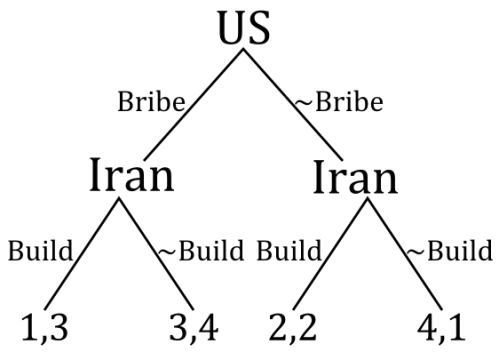
Let’s boil it down to the simplest version of the game possible. The United States has two options: bribe or not bribe. Iran sees the US’s move and decides whether to build a nuclear bomb. American preferences (from top to bottom) are as follows: not bribe/not build, bribe/not build, not bribe/build, bribe/build. Iranian preferences are as follows: bribe/not build, bribe/build, not bribe/build, not bribe/not build.

(I derive these utilities from a more general bargaining setup, so I suggest you look at the paper if you think these seem a little off. I personally wouldn’t blame you, since it seems strange that Iran prefers accepting bribes to taking bribes and proliferating anyway.)

Given that, we have the following game:
b4bgame

By backward induction, Iran builds if the US does not bribe but does not build if the US bribes. In turn, the US bribes to avoid having Iran build.

Great! Iran should not proliferate. But…yeah…that’s not happening at the moment. Why?

One problem is the reason why Iran prefers not building if the United States is bribing. The idea here is that bribes are permanent. By continuing to receive these bribes for the rest of time, Iran sees no need to proliferate since it is already raking in the concessions and nuclear weapons will only waste money.

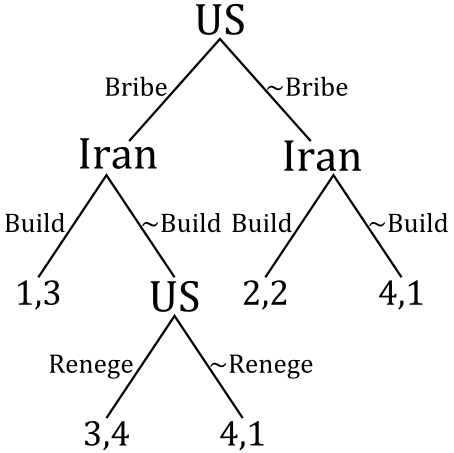
But what if the United States had the power to renege on the concessions? In the future, the US will no longer be suffering from war exhaustion from Afghanistan and Iraq and will force Iran not to proliferate by threat of preventive war. At that point, the US can renege on the bribe without any sort of repercussions.

Again, boiling the argument down to the simplest game possible, we have this:
warexhaustion

Backward induction gives us that the US will renege (why give when you don’t have to?). So Iran builds regardless of whether the US offers a bribe (it’s a ruse!). Proliferation results today because the United States can treat Iran as essentially nuclear incapable in the future. Iran has a window of opportunity and must take it while it can.

This is neat because a commitment problem sabotages negotiations. Recovering from war exhaustion makes the United States stronger in the sense that it will be more willing to fight as time progresses. Yet, this additional strength causes bargaining to fail, since Iran fears that the United States will cut off concessions at some point down the line. More power isn’t always better.

In addition to discussing Iran, the chapter also talks about the Soviet nuclear program circa 1948, which is fascinating. We often take Moscow’s decision to proliferate as a given. Of course the Soviet Union wanted nuclear weapons–there was a cold war going on! But this doesn’t explain why the United States didn’t just buy off the Soviet Union and avoid the mess of the Cold War. Certainly both sides would have been better off without the nuclear arms race.

Again, war exhaustion sabotaged the bargaining process. The United States was not about to invade Russia immediately after World War II ended. Thus, the Soviets had a window of opportunity to proliferate unimpeded and chose to jump through that window. The U.S. was helpless to stop the Soviet Union–we had zero (ZERO!) spies on the ground at the end of WWII and thus had no clue where to begin even if we wanted to prevent. The same causal mechanism led to intransigence in two cases separated by about 60 years.

If this argument sounds interesting to you, I suggest reading my chapter on it. (Apologies that some of the internal links will fail, since the attachment contains only one chapter of a larger project.) I give a much richer version of the model that removes the hokeyness. Feel free to let me know what you think.
Are Simple Models Bad? No!

Here is a frustrating critique of formal/game theoretical modeling:

The model the author presents is way too simple and completely divorced from reality. Therefore, we ought to ignore its conclusions.

Such comments pop up frequently. They are frustrating because they are grounded in ignorance. There is an implicit belief that formal modelers are attempting to match reality. With that as the premise, models fall woefully short. Consequently, the critics reject them.

However, I know of no serious modeler claims to or even wants to match reality. Formal modeling acts as accounting standards that verify or reject theories of causation. That’s it. That’s all. There’s nothing more. And that’s perfectly okay.

For example, consider the following argument on why countries develop nuclear weapons:

  1. Countries with rivalrous relationships are in competition for scarce resources.
  2. All other things being equal, countries with nuclear weapons receive more of the scarce resources.
  3. If the cost of the nuclear weapons is worth less than the additional amount of resources they bring in, we should expect a country to proliferate.

I just gave you the conventional wisdom about nuclear proliferation. I doubt many would criticize this as being too simplistic to reflect reality. For some reason, informal arguments have a certain immunity to this type of criticism. Perhaps this is because they do not explicitly detail what any of these assumptions mean–that nuclear weapons cost exactly $k, that power is equal to p, that the costs of war are c, and so forth. Yet, implicitly, those types of assumptions are present in the informal argument. And our inability to grasp that without formalization puts us in deep trouble.

As it turns out, the conventional wisdom is wrong. There normally exist bargained settlements that leave both sides better off than had the potential proliferator obtained nuclear weapons. A simple model illustrates this, and you can find the proof in this paper.

Yes, this model is way too “simple” and is completely divorced from reality. But so is the informal explanation I gave above. The English words make it feel more comfortable than Greek letters. But the critical difference is that the Greek letters show that the English words are wrong. And that is why modeling is useful. (And awesome.)

Life is a gigantic tradeoff. When anyone crafts a theory–formal or informal–they are simplifying reality into digestible bits. There is no shame in doing this, since indigestible chunks are completely worthless. Formal modeling is just really good at identifying logical inconsistencies.

This allows us to take the informal logic a bit deeper. For example, if the three above assumptions do not imply proliferation, what does? Sometimes, the second question is more interesting than the first.

Whenever you look at a model, ask a simple question: does this model help me understand the world better? If the answer is yes, then accept the model for what it is–a much simplified (but useful!) version of reality. If the answer is no, then feel free to hate it with a passion.

Humanitarians Should Love War

Earlier this morning, the front page of Reddit had a TIL Congresswoman Jeannette Rankin voted against WWII thread. The comments made me go insane. Unsurprisingly, the thread attracted a large anti-war crowd. It shocked me how untenable their general position is.

On the surface, the logic seems fine. These pacifists appear very pro-humanitarian, and the argument is straightforward:

Premise 1: War kills.
Premise 2: Killing people is bad.
Conclusion: Therefore, we should never go to war.

Premise 1 is trivially true, so no complaint there. Premise 2 is frustratingly trivial–killing people is obviously bad. The only people who disagree with this are psychopaths or soulless war profiteers. Both groups are such a small percentage of the population that they may as well be irrelevant.

But that conclusion? Dear goodness, how absurdly naive!

We do not live in a vacuum. Our choices are not “war” or “no war.” International relations is strategic. We can only control our own actions. If we don’t fight, there is no magical button we can press that stops everyone from fighting.

Yet, as far as I can discern, the anti-war group lives in a fantasy world in which this is possible. And that makes me bang my head against the wall. Repeatedly.

What are we supposed to make of this? Should we be ashamed of our actions in the Persian Gulf War? Yeah, we killed a lot of people. But the alternative was let Saddam Hussein takeover Kuwait, which seems even worse.

What about our intervention in Libya a couple years ago? We killed people, sure. So what? Are we just supposed to let Mummar Gaddafi kill civilians relentlessly?

In fact, if you are a true humanitarian, you should be advocating more war, not less. The world has no shortage of bad dictators that the world would be better off without. Currently, we could be in Syria working to remove Assad from power.

The only reason we don’t is because we are selfish. War with Syria would be costly to us. Even though the Syrian people’s gain would probably outweigh our loss, we don’t fight because…well, we just don’t give a damn.

Thus, no-war humanitarians live in a fantasy world of false dichotomies. In reality, the world presents us with three options: (1) wars against everyone, (2) wars only against bad people, and (3) no wars.

Very few people think option (1) is a good idea. But a true humanitarian should fall decisively into the option (2) camp, even as most of us fall between (2) and (3). And that’s why a humanitarian should be more pro-war than the average person.

War sucks. I get it. I’d like to be the benevolent dictator of the world, fix all social injustice, and end all conflict. But we live in a world of harsh realities, not idealistic fantasies. Life is a tradeoff. Sometimes, we cannot reach humanitarian outcomes in any reasonable length of time without fighting.

If you think we should never go to war, then you need to accept the fact that you just don’t care about people in far-flung areas of the world dying because they have an evil government. Most of us already do–even if we don’t admit it to ourselves–and that’s why we don’t have troops on the ground everywhere and higher taxes to fund those efforts.

ratwar3d

Explaining Iranian Nuclear Intransigence

Iran is almost certainly trying to build a nuclear bomb right now. For the past four years, President Obama has been trying to get Iran to back down with a combination of rewards for nonproliferation and sanctions in the meantime. Why has Iran ignored us thus far?

A lot of people believe that you simply cannot appease rising states in this manner–they need weapons to secure concessions, so bargaining is fruitless. A few years ago, I was one such person. But in my effort to verify what I thought, I discovered I was wrong, and turned my results into an interesting paper. Settlements almost always leave both sides better off, even if the rising state can freely take the concessions and proliferate anyway.

So, again, why is Iran trying to proliferate?

I have a working paper that I think provides a reasonable explanation. (It is still preliminary, so I am not posting it here. Please email me and I will gladly send you a copy, though.) Conventional wisdom portrays Iran as the villain and us as the good guys. But if you think about the situation from their perspective, Iran’s motivation will be obvious.

The United States has always had a bad relationship with Iran since the revolution. There was a glimmer of hope on September 11, 2001 when Iran (quietly) assisted us with the invasion of Afghanistan. But that cooperation tanked when Bush declared Iran part of the “axis of evil” a few months later. This infuriated Iran, and things went cold for a couple of years.

Nevertheless, Iran again extended an olive branch in May 2003 in a remarkable effort that has amazingly escaped our collective memory. Iran put everything on the table–full diplomatic relations, dropping the nuclear program, recognition of Israel, ending support of Hezbollah, help with al-Qaeda–and asked for shockingly little in return. It is the type of deal we would jump at today, so much so that it is difficult to believe it was within our grasp just nine years ago.

How did Bush respond? He didn’t.

Yes, you read that correctly. The Bush administration completely ignored the offer.

So consider how Iran views Obama’s overtures. Iran knows the United States is weak right now–yet another war in the region would be difficult at the moment. So Iran has two choices. Option one is to proliferate now while it is still an option and force the United States to play ball in the future. Option 2 is accept Obama’s concessions now and hope the United States will continue them into the future without the threat of nukes in the background. Given the experience from 2003, which would you choose?

The unfortunate part is how inefficient the result is. Both sides would be better off if the United States could credibly commit to continued concessions into the future. But because the U.S. cannot, we are stuck with Iran attempting to go nuclear.

Of course, this does not mean proliferation will certainly be the ultimate outcome. Trade sanctions could lead to some domestic shock which changes Iranian priorities entirely. The proliferation process itself is uncertain as well; it is possible that Iran will find that proliferation will take too long and ultimately give up. But until we reach that point, don’t expect U.S.-Iranian relations to suddenly thaw.

The Sad Life of a Formal Theorist

A bunch of my friends started posting Wordles of their academic papers. I thought it would be fun to try it for my “Invisible Fist” paper. The results were disappointing:

ch2

Apparently, I am not writing about nuclear proliferation. (Proliferation is barely visible.) No, I am writing about discount factors and \frac, the LaTeX command used to write fractions.

At least state is the third most prominent word.

The “You Are Imperfect Ergo You Are Worthless” Fallacy

Here is a generic criticism that has been, is, and will be levied at forecasting models like Fivethirtyeight and Votamatic:

The forecasting models fail to account for x, y, and z. But x, y, and z are fundamentally important! Therefore, we should not use the forecasting models.

Fallacious! I think we can all agree that, for various reasons, being able to predict the outcome of elections is important. We cannot just stop forecasting tomorrow. Given that, the question is a matter of what methodology we use to predict outcomes.

In that light, the above criticism fails to highlight the real question. Rather than asking “are forecasting models perfect?” we should be asking “are forecasting models better than the alternative?” In other words, we should treat what we currently have (talking heads on Fox News, CNN, and MSNBC) as the null hypothesis and the forecasting models as the alternative hypothesis. And that being the case, the forecasting models beat the hell out of political punditry.

Yet, the full criticism we often hear is this:

The forecasting models fail to account for x, y, and z. But x, y, and z are fundamentally important! Therefore, we should not use the forecasting models and instead keep pretending my inane rants actually have meaning.

Of course, the political pundit’s inane rants have absolutely no meaning. The pundit is quick to criticize what he does not like but then gives himself a free pass. However, not only does his punditry fail to account for x, y, and z, it is also completely made up horse manure, often fabricated for the sake of ratings. (Or page views…coughunskewedpollscough…)

Now, we should not take forecasting models completely off the hook. They have problems, and their creators are the first to admit that. But, as with anything else in life, we need to ask ourselves whether this devil is better than the other devil. And personally, I’d rather have Nate Silver’s pitchfork pointed at me than Joe Scarborough’s.

Unskewed Polls Guy Is a Genius

Within a few hours (hopefully), we will know who won Ohio, and this election season will mercifully come to a close. All of the sophisticated forecasters agree: Obama is going to win Ohio and therefore the White House. (See Nate Silver and Drew Linzer.)

However, there is one unsophisticated forecaster who is convinced everyone has it wrong. His name is Unskewed Polls Guy. He is convinced that Romney is going to win. Why? Well, Unskewed Polls Guy’s methodology is that we should take all the state polls and arbitrarily add 5% or so to Romney’s total. Or something. Why? Well…uhh…the polls are skewed toward Obama. Or something. Hence, Unskewed Poll Guy unskews the polls by throwing votes Romney’s way. Or something.

As the last paragraph illustrated, I have absolutely no respect for Unskewed Polls Guy’s methodology. To say he is pulling numbers out of his…ahem…would be gentle. Hell, up until today, he had Oregon as a state Romney could potentially win. Oregon. Oregon? OREGON.

But my post title is not sarcastic: Unskewed Polls Guy is a true genius. Here’s why. First, regardless of the election results tonight, Unskewed Polls Guy is already a winner. His website gets a ton of traffic, half from crazy conservatives who believe math is a false paradigm and think he truly is unskewing polls and half from sane people (both liberal and conservative) who find his lunacy to be highly entertaining. The inaccuracy of his forecasting has brought him a substantial bounty–precisely due to how horrible his forecasting is. Brilliant!

But that’s not the real genius of Unskwewed Polls Guy’s ignorant plot. Suppose the other forecasting models do get it “wrong”–that is, the outcome of the election is far away from the mean prediction. This is well-within the realm of possibility. Silver’s model gives Romney a 9% chance to win. That is substantial, and you generally need 95% confidence to get published in social science. Put differently, social scientists would a Romney victory odd but not altogether shocking.

Of course, if this election cycle has taught us anything, it is that the media has absolutely no clue how the forecasting models work. 24/7 cable news has been embarrassing for a while now, but this has gone to a whole new level. If Romney wins, they will treat Unskewed Polls Guy as a prophetic god. He will be the hottest media commodity for the next two weeks. He will get a book deal. He will make a large sum of money. And why? Because he is a complete idiot, has no clue what he is doing or why he is doing it, and just happened to accidentally hit a miracle. If it has happened with an octopus, the frenzy will certainly happen with a human.

And that’s the real genius. If Obama wins, Unskewed Polls Guy takes home a lot of advertising revenue from the past few weeks, and we all forget about him. If Romney wins, Unskewed Polls Guy hits the jackpot. Consequently, if Unskewed Polls Guy is trolling us all, my hat is off to him. If I had thought about this a year ago, I might have been Unskewed Polls Guy.

Going forward, forecasters have awkward incentives. Fivethirtyeight has pretty much cornered the market. You would think that a forecaster should just maximize his chances of being right. But that pretty much means copying Nate Silver. So, to become famous, you really ought to make ridiculously crazy predictions, hope nature randomly makes you right, and reap the short-term rewards. Long-term, you are screwed. But who cares if you’ve already received your book advance?

Book Review: The Evolution of Cooperation

Book: The Evolution of Cooperation by Robert Axelrod
Five stars out of five.

Suppose two generals each have two choices: attack or defend. The decisions are simultaneous and private. Military strategy favors the offensive, so both really want the other guy to defend while he attacks and really does not want to defend while the other guy attacks. On the other hand, war is extremely bloody. Both generals agree that mutual defense is better than mutual aggression. What should we expect the generals to do?

Intuitively, you might think that mutual defense is a reasonable outcome since peace is an agreeable outcome. However, this fails to appreciate individual incentives. If one general knows the other will play defensively, he should take advantage of his rival’s cooperation and attack. As a result, mutual aggression is the only sustainable outcome. But war is worse for both parties. This is the tragedy known as the prisoner’s dilemma: both parties end up in a mutually despised outcome but cannot commit to the better result due to their selfish individual incentives.

The prisoner’s dilemma has been around since the 1950s. For the next three decades or so, game theorists speculated that repeated interaction could solve the cooperation problem. Perhaps war favors the aggressor, but only a slight degree. If so, the generals could agree to maintain the peace as long as the other guy did. But the moment one slips up, the generals will fight all-out war. The threat of a painful breakdown in peace might incentivize the generals to never start conflict, even if a surprise attack might yield short-term benefits.

However, the cooperative solution remained elusive…until Robert Axelrod’s The Evolution of Cooperation. For a three sentence summary, Axelrod shows that these generals can adopt a “grim trigger” strategy and credibly promise infinite punishment in the future to enforce cooperation in the present. Thus, even bitter rivals can maintain friendly relations over the long term. In essence, we can rationally expect cooperative relationships in even the worst of environments.

Despite how I glossed over all of the intricacies of the repeated prisoner’s dilemma, The Evolution of Cooperation is a must-read for that result alone. But the book is so much more. I first picked it up during my junior year of college. I hadn’t taken a math class in five years, and the grade in that class was a C. Yet, despite the sophistication of the argument, I understood exactly what was going on. Axelrod’s exposition of formal theory in this book is quite simply the best you will ever see.

The fourth chapter is nothing short of awesome. Axelrod takes cooperation to the limit in his study of the “live and let live” trench warfare system during World War I. For a significant chunk of the war, troops spent most of their time deliberately shooting to miss their enemies in the opposing trench. While shooting and killing an enemy soldier provided a marginal gain should a battle take place, said act of shooting risked sparking a larger battle which would cause great causalities on both sides. Thus, for the sake of self-preservation, armies avoided fighting. This culminated in the famous Christmas Truce, in which the troops actually got out of their trenches and began fraternizing with the so-called enemies. (In that vain, you should watch Joyeux Noel if you have not already.)

If there is one issue with the book, it is the emphasis on tit-for-tat. Tit-for-tat is a less aggressive way of responding to your opponent’s aggression than grim trigger; rather than punishing forever, you merely punish at the next available opportunity. Axelrod correctly identifies a bunch of nice properties of tit-for-tat, especially how well it plays nice with others. However, as every modern game theorist knows, tit-for-tat is not subgame perfect and thus is extremely questionable on theoretical grounds. Of course, we would not have found out about that had this book not existed, so this just further solidifies how important The Evolution of Cooperation is.

In sum, go out and buy it. The book has applications to game theory, economics, political science, sociology, evolutionary biology, and psychology. If you are reading this blog, you likely have an interest in one or more of those fields, so you should pick it up.

Game Theory 101 MOOC Completed

My Game Theory 101 MOOC (massive open online course) has been completed for Fall 2012. Conveniently, you can watch the entire series below, find the playlist on YouTube, or take the course via Udemy.

The course covers basic complete information game theory and has an accompanying textbook. Enjoy!

P.S. Here’s a (partial) list of the things it covers: prisoner’s dilemma, strict dominance, iterated elimination of strictly dominated strategies, pure strategy Nash equilibrium, best responses, mixed strategy Nash equilibrium, matching pennies, the mixed strategy algorithm, calculating payoffs, battle of the sexes, weak dominance, iterated elimination of weakly dominated strategies, infinitely many equilibria, extensive form games, game trees, backward induction, subgame perfect equilibrium, tying hands, burning bridges, credible commitment, commitment problems, forward induction, knife-edge equilibria, comparative statics, rock paper scissors, symmetric games, zero sum games. Okay, that was a fairly complete list.

Popular Vote Matters? Only in a Fantasy World

As election day draws near, the chances of Mitt Romney winning the popular vote but losing the electoral college appears somewhat likely. If 2012 is anything like 2000, many Romney supporters will claim that Romney should be president because more people voted for him, just as supporters of Al Gore claimed that Gore should be president because he received more votes than George W. Bush.

With this post, I hope to prevent lunacy from proliferating around the United States. Anyone who thinks that the winner of the popular vote should be president needs to take a step back and understand that electoral strategies are a function of the rules of the game. If we change the rules of the game, we change the way the campaigns play. If you think that the popular vote is a better metric to select a president, that is perfectly fine. But you absolutely cannot use next Tuesday’s vote count to select a president based on that metric.

To use an analogy, to say the winner of the popular vote should win the presidency is the same as saying the team with the most hits should win a baseball game. The U.S. Constitution stipulates that only the electoral college matters. The candidates tailor their electoral strategies accordingly. Likewise, the rules of baseball stipulate that only the number of runs scored matters. The teams again strategize accordingly. A game of baseball to maximize hit differential looks fundamentally different than a game of baseball to maximize run differential. Sacrifice bunts would be completely off the table; bunting for a base hit would become much more frequent.

If only the popular vote mattered, the campaigns would be far different. The candidates would not pay such fervent attention to Ohio, since Ohio votes would count the same as Oregon votes, or Texas votes, or Maine votes. Campaign money would diffuse all over the country. Individual voters’ actions would change as well. A voter in California can rationally choose not to vote in next Tuesday’s election, since it is abundantly clear that Obama will win the state in a landslide, and therefore his vote is strategically irrelevant.[1] But if we changed how we count the votes, that would change that Californian’s incentives and might alter his decision to abstain.

Thus, we cannot use next Tuesday’s electoral vote count to decipher who would have received more votes in the world where we decide elections without the electoral college. Consequently, anyone who argues that Gore should have been elected in 2000 based off that vote has a defenseless argument[2] The same goes for anyone who says something about Romney next week, in case of an electoral/popular vote split.

On the other hand, to say that we should remove the electoral college from play is defensible. There is good theoretical reason to believe that simple majority votes are better able to pick the “better” of the two candidates, supposing there exists some sort of metric that makes Romney better than Obama or vice versa.[3] And personally, I am annoyed that all of the elections in my post-childhood lifetime have basically been decided by a handful of states, and the system perversely requires the candidates to spend all of their time, energy, and money in those states.

[1] See the paradox of voting:

[2] I, as a 13 year old during the 2000 election, was included in this group. My perspective has improved a great deal in the last twelve years.

[3] http://en.wikipedia.org/wiki/Condorcet_jury_theorem