Negotiating with Iran: Credible Commitment Problems?

The United States, the rest of the permanent members of the United Nations Security Council, Germany, and Iran are in Kazakhstan this week, negotiating over the Iranian nuclear program. The West wants it to stop, fearing it will eventually yield a nuclear weapon. Iran continues to claim that its program is purely for scientific and energy purposes. No one believes that. The United States’ focus has therefore been figuring out how to convince Iran to let it go.

Unfortunately, the dialogue in the U.S. has been hopelessly misguided. In this post, I will make two claims: (1) the United States can always offer sufficient concessions to induce Iran to end its program; (2) Iran does not believe the United States can credibly commit to these concessions over the long term, thus explaining Iran’s obstinate behavior. The policy implication is obvious: if we want Iran to stop proliferating, we need to stop pretending that it is difficult to buy Iranian compliance and start seriously questioning our own commitment to giving Iran a good deal.

I discuss claim (1) in the main theoretical chapter of my dissertation. Many years ago, I saw President Obama making a speech about getting Iran to join “the community of nations” and give up its nuclear program. From my knowledge of the existing political science literature, I figured it would be easy to show that no such agreement would work. After all, if you were Iran, why would accept concessions and not build when you could accept concessions and build anyway? The temptation to shift power seemingly destroys the possibility of negotiated settlements.

However, I was unequivocally wrong. The conversation about Iranian duplicity (and my own initial intuition) fails to properly analyze Iranian incentives. Nuclear weapons are costly. If Iran is offered most of the concessions it expects to receive if it were to proliferate, it has no further incentive to develop a bomb. Sure, Iran could continue proliferating, but it ultimately will not receive any more than the United States is already giving it. However, it will have to pay the cost of the weapons, which is a complete waste at that point.

Meanwhile, the United States has incentive to make this sort of “butter-for-bombs” offer. Although the U.S. would like to offer no concessions, such a strategy is naive, since this would induce Iran proliferate. On the other hand, offering the butter-for-bombs deal ensures that Iran will not build nuclear weapons. Moreover, since Iran is not paying the cost of proliferation, there is extra pie to go around. The United States can extract it.

The paper linked above gives the details. Surprisingly, these agreements work under very loose conditions. They work in an infinitely repeated interaction; they work when Iran could freely renege on the deal without any recourse from the United States; and they work even when the United States is completely incapable of observing Iranian nuclear progress. Butter-for-bombs is all about getting the incentives right. Offer Iran enough, and you do not have to worry about the deal falling through under any circumstance.

One important assumption of the above model is that the United States’ ability to launch preventive war remains constant through time. What happens if we relax this assumption? Another chapter from my dissertation asks this exact question. I show that if the United States goes from being unable to credibly threaten preventive war one day to being able to credibly threaten preventive war the next day, bargaining breaks down, and Iran develops nuclear weapons. But the blame goes squarely on the United States.

To understand why, suppose we reach the future time when the United States can credibly threaten preventive war. At this point, Iran cannot develop nuclear weapons. If it were to, the United States would respond by launching preventive war. Iran would not receive the benefits of nuclear proliferation but still waste the cost it paid to develop nuclear technology. Internalizing this, Iran will not proliferate. But because Iran will not proliferate, the United States has no reason to make those butter-for-bombs offers from before. Instead, it can offer no concessions and still induce Iranian compliance, as Iran does not have any better options.

Now think about how this endgame affects bargaining today. The United States would like Iran to accept a butter-for-bombs agreement and avoid proliferation. But consider the problem from the Iranian perspective. If Iran accepts those concessions today, then it advances to that future world where the United States can effectively leverage preventive war. At that point, the concessions stop. Alternatively, Iran could pay a cost upfront, proliferate today, and leverage the additional power to force the United States to continue giving concessions into the future. Needless to say, the second option looks a lot more attractive. Thus, bargaining breaks down, and Iran proliferates.

The problem here is not Iran’s stubbornness. Rather, it is the United States’ inability to credibly commit to continue providing concessions in the future. If the U.S. could, then Iran would have no reason to proliferate. (This was shown in claim 1.) However, Iran expects the United States to renege on the concessions, which in turn causes the proliferation behavior.

One might object that the United States would never take advantage of its strength in that manner. To anyone who doubts that, I point to May of 2003. This was the perhaps the height of American power. Things were going well in Afghanistan, we had just run over Saddam Hussein’s army, and the Iraqi insurgency had not yet begun. Iran felt enclosed. Rather than panicking, Iran extended an olive branch. Tehran sent the Swedish ambassador (who takes care of American interests in Iran) over Washington with a sweeping offer. Iran essentially waved a white flag and put everything on the table. Their demands in return were minimal: they wanted a prison swap and normalized relations. If this type of proposal arrived today, it would be magical Christmas land in DC.

I’d like to say that the Bush administration gleefully accepted the offer and sent a warm reply. But they didn’t. In fact, they sent no reply at all. They simply ignored it and chastised the Swedish ambassador for bringing it to their attention.

Seriously.

The domestic political consequences in Iran were bad. Moderates held the presidency at that point and pushed for the deal with the Ayatollah’s blessing. After their failure, they were pushed out of government. Mahmound Ahmadinejad’s administration replaced them.

As we all know, America’s position of strength evaporated, leading to the drawn-out insurgency. Iran knows that the decade-plus of war has left us exhausted from conflict. Preventive war is unlikely today. But given enough time, our war-weariness will fade away. Iran is concerned that the United States will immediately switch back to the firm fist of the Bush administration’s years. They see our temporary weakness as now-or-never opportunity to proliferate. And they are going for it.

How do we get out of this mess? It’s possible that we cannot, and we just have to suffer the consequences of another poor foreign policy decision from the Bush years. But if there is any hope of reaching an agreement with Iran, it must come through the United States demonstrating its commitment to ongoing concessions that will not instantly disappear at some later date. Unfortunately, the domestic political dialogue in the U.S. focuses entirely on the credibility Iranian commitments while treating our own as the word of God. This is misguided. And until we can have a serious conversation about our own credibility, we will not make any progress with Iran.

Wheel of Fortune’s Most Frequent Bonus Round Letters

C M D A? Try H G D O.

I have been watching Wheel of Fortune for more than 20 years now–my parents even tell me that the game taught me how to read. And all the while I have unquestionably thought that the best letters to call during the bonus round are C M D and A. But watching the program last night, I realized I had no factual basis for that. It was a belief. It was not science.

So I figured I would do some quick Googling and find out what the best letters actually were. Turns out, it seems no one has figured this out yet. (The best result was some dude on Yahoo! Answers, which wasn’t exactly reassuring.)

No problem. I found this website, which archives Wheel of Fortune bonus round puzzles and other associated information. It has a complete record from 2007-2012, or 1166 total puzzles. I scraped the data and began my analysis. Here are some of the important findings:

1) I am not a lone in my belief: C M D A are the four most frequently called letters at 64.6%, 59.9%, 57.9%, and 48.3%, respectively.

2) P H O G are the next four in order at 38.2%, 34.5%, 31.1%, and 21.0%.

3) O is the most common letter to appear in puzzles, consuming 9.5% of all letters. This just goes to show you that the bonus round puzzles are not a random sample of words from the English language–in real life, O is the fourth most common letter after E, T, and A.

4) Despite being the most common letter in English, E is the fourth most common letter in the puzzles after O, I, and A. Ostensibly, they give you R S T L N E for free because they are common letters. However, the producers intentionally pick puzzles where those letters don’t show up. Like cake, the value of R S T L N E is a lie.

5) M is an awful pick, ranking 21st on the list. It only accounts for 2.1% of the letters. Only V, J, Q, Z, and X are less frequent. No one ever calls V, J, Q, Z, or X unless they already know the answer to the puzzle and want to show off. Yet 57.9% of players pick M. Go figure.

6) H is a great selection. It has a frequency of 4.6%, placing the highest among non-R S T L N consonants. It ranks just slightly below the least frequent vowel (U, 4.7%) but higher than N (4.5%), S (3.8%) and L (3.7%).

7) If you solely want to maximize the number of letters that are revealed, H G D O is the best selection. D (3.5%) is very close to P and B (both 3.4%), so there is some wiggle room here.

To hammer home the point, the plot below shows the frequency of called letters versus what appears on the board (click to enlarge):

wheelplot

The mess on the bottom left corner is the V, J, Q, Z, X trash.

A couple of notes before I wrap this up. First, I want to emphasize the distinction between “most frequent letters” versus “best letters.” What shows up most frequently might not be the most useful in terms of actually solving the puzzle. G’s frequency might be overrated since a lot of those come from -ING suffixes, which you could reasonably guess if you see a word like _ _ _ _ _ N _.[1] Letters like C, B, or P might have an advantage in that they could appear at the beginning of words more frequently and are thus more valuable. This is something I could check on later.

This segues to the second point nicely. There are a bunch of interesting questions we can now answer now that I have this dataset. Expect more investigative posts like this in the future.


[1] The category What Are You Doing? only appears 9 out of 1166 times. Since this category always begins with a word ending in -ING, having the G be revealed in that slot is worthless to a contestant. But even if you remove those puzzles from the sample, G ranks much higher than the nearest alternatives.

Preemptive War on the Walking Dead

The Walking Dead is cable’s most successful TV show, ever. I’m writing this after “Home,” and I’m going to assume you know what is going on by and large.

Here’s what’s important. As far as we care, there are only two groups of humans left alive. One, the good guys, have fortified themselves inside an abandon jail. The other lives in a walled town called Woodbury. They became aware of each other a few episodes ago, and they have various reasons to dislike each other.

War appears likely and will be devastating to both parties, likely leaving them in a position worse than if they pretended the other simply did not exist. For example, in “Home,” the Woodbury group packs a courier van full of zombies, breaches the jail’s walls, and opens the van for an undead delivery. Now a bunch of flesh-eaters are wandering around the previously secure prison.

Meanwhile, the jail’s de facto leader went on a mysterious shopping spree and came back with a truck full of unknown supplies. I suspect next episode will feature the jail group bombing a hole in Woodbury’s city walls.

All this leads to an important question: why can’t they all just get along? It’s the end of the world for goodness sake!

As someone who studies war, I am sympathetic to the problem. Woodbury and the jail group are capable of imposing great costs on one another merely by allowing zombies to penetrate the other’s camp. The situation seems ripe for a peaceful settlement, since there appear to be agreements both parties prefer to continued conflict.

This is the crux of James Fearon’s Rationalist Explanations for War, one of the most important articles in international relations in the last twenty years. Fearon shows that as long as war is costly and the sides have a rough understanding of how war will play out, then both parties should be willing to sit down at the bargaining table and negotiate a settlement.

However, Fearon notes that first strike advantages kill the attractiveness of such bargains. From the article:

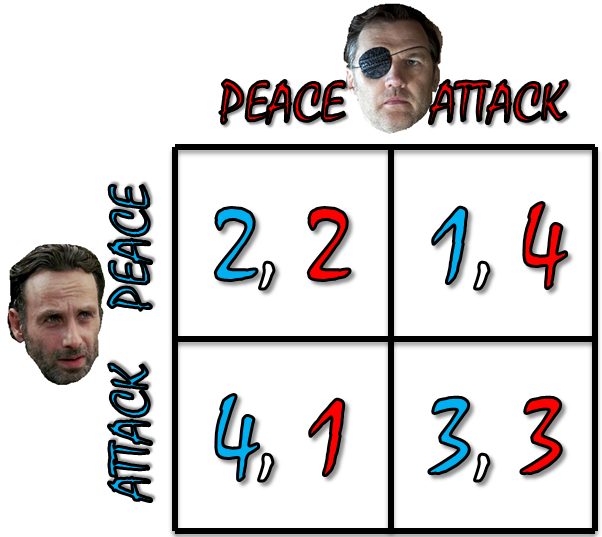
Consider the problem faced by two gunslingers with the following preferences. Each would most prefer to kill the other by stealth, facing no risk of retaliation, but each prefers that both live in peace to a gunfight in which each risks death. There is a bargain here that both sides prefer to “war”…[but] given their preferences, neither person can credibly commit not to defect from the bargain by trying to shoot the other in the back.

The jail birds and Woodbury are in a similar position:

pd

This is a prisoner’s dilemma.[1] Both parties prefer peace to mutual war. But peace is unsustainable because, given that I believe you are going to act peacefully, I prefer taking advantage of you and attacking. This leads to continued conflict until one side has been destroyed (or, in this case, eaten by zombies), leaving both worse off. We call this preemptive war, as the sides are attempting to preempt the other’s attack.

In the real world, countries have tried to reduce the attractiveness of a first strike by creating demilitarized zones between disputed territory, like the one in Korea. But such buffers require manpower to patrol to verify the other party’s compliance. Unfortunately, the zombie apocalypse has left the world short of people–Woodbury has fewer than a hundred, and the jail birds have fewer than ten. As a result, I believe we be witnessing preemptive war for the rest of this season.

[1] Get it? They live in a jail, and they are in a prisoner’s dilemma![2]

[2] I’m lame.

Theory, Assumptions, and a God-Awful Final Jeopardy

In case you missed it, last night’s Final Jeopardy was flat terrible. This was the semifinal game in the teen tournament; only the top (strictly positive) scorer advanced to the next round, and no one keeps any money. The scores were $16,400, $12,000, and $1,200. The Final Jeopardy category was capital cities. Pretend you are the leader and place your wager.

Ready? Cue music:

It’s criss-crossed by dozens of “peace walls” that separate its Catholic & Protestant neighborhoods

Was your response Dublin? Mine was, as was all of the contestants’. Dublin is also wrong. The correct response was Belfast.

Nothing wrong with a triple stumper, though. The wagering strategies, on the other hand, were horrible. Every contestant wagered everything. With no one coming up with the correct response, no one had any money and thus no one qualified for the finals.

This made me go insane. The leader had no reason to wager more than $7,601; such a wager ensures that the leader wins with certainty if he receives the correct response and also gives him a win against a wider variety of opposing bids, including the set of bids from the game. In game theory terms, wagering $7,601 weakly dominates wagering everything.

I then vented in YouTube form:

Here’s a comment from the YouTube view page:

This is why the idea that people are intelligent self interested agents makes me laugh. People do this kind of thing ALL THEο»Ώ TIME, and it’s why economic theories that don’t account for this can’t predict [stuff].

Only he didn’t say stuff.

There are two big problems with this logic. First, rational self-interest is an assumption. We use assumptions to build theories not for their accuracy but for their usefulness. The better metric for modeling is a simple question: is this model more useful than the alternative? If yes, the model is satisfactory. If not, then use the alternative. We could discard certain reality and instead use some probability distribution over rational agents and automaton agents. While this would certainly be a more realistic model, it would come at the expense of being substantially more computationally intensive without much obvious reward. We should find no inherent shame in simplicity.

Second, a good theory explains and predicts behavior. Theories are not laws–we should not require a theory to hold 100% of the time for us to find a theory useful. Contrary to what the commentator wrote, we can use “intelligent, self-interested agents” as an assumption and predict quite a lot. In fact, the reason Final Jeopardy last night caused such a stir is because it egregiously violated what intelligent individuals should do. Intelligent individuals make up about 99.9% of the Jeopardy players, which is what made last night so extraordinary.

If models are useless because of the .1%, then all of academia–hard and soft science alike–needs to close up shop immediately.

Panetta’s Second-Rate Understanding of Defense Spending

Leon Panetta, the outgoing U.S. Secretary of Defense, made an interesting claim during his exit interview. Automatic defense budget cuts will take place on March 1 unless Congress reworks the Pentagon’s allotment. Panetta urged Congress to act, saying that if the ten year, $500 billion cuts take effect, the U.S will become a “second-rate power” (his words).

$500 billion is a lot of money, so you may be inclined to agree. But anyone who has spent more than ten seconds looking at world defense spending would know the absurdity of Panetta’s claim.

Take a look at this Wikipedia article on defense spending. SIPRI keeps good data on defense expenditures around the world[1], and the Wiki gives a nice comparative visualization. Last year, the world’s militaries consumed about $1.7 trillion.

The U.S.’s share? $711 billion.

That’s approximately 41% of the entire world’s spending.

It’s more than Chinese (8.2%), Russian (4.1%), British (3.6), and French (3.6%) spending…combined.

It’s more than every non-permanent member of the United Nations Security Council…combined.

So, the U.S. isn’t exactly at a crossroads when it comes to military spending.

Moreover, $500 billion over the course of ten years comes out to $50 billion a year. That would still give the United States $661 billion in defense spending, still 39% of the new world’s spending and more than 4.5 times as large as China’s receipts. Thus, even if you think of China as having a second-rate military, ours would still be substantially better.

I understand that $50 billion will result in meaningful cuts to our military. But the United States needs to reduce spending somehow. Among all the alternatives, this one seems relatively painless.

[1] SIPRI has to estimate expenditures from a lot of countries, notably China and Russia. While their figures may be underestimates, SIPRI would have to have made massive mistakes for the effects to be relevant to the argument.

Does the Vice President’s Vote Matter?

Growing up, I remember my parents telling me about the vice president’s role in the Senate. As president of the Senate, the VP only casts a vote in the event of a 50-50 tie among the senators. Thus, the VP rarely ever casts a vote.

But, as my parents explained, the VP’s vote only matters if there is a tie. If the Senate’s vote was 51-49, or 63-37, or 100-0, the VP’s vote will not change the outcome. So, functionally speaking, the VP has full voting power in the Senate.

Fast forward about fifteen years. Presh Talwalkar had a post on Mind Your Decisions this evening on the very same point. After reading the entry, it hit me there is a major caveat: the filibuster.

For quick review, the Senate only votes on a bill if 60 senators vote to close debate. (If not, someone can “filibuster,” or aimlessly continue creating fake debate, to prevent an actual binding vote.) Thus, despite only needing 51 votes to pass a bill, you really need the tacit approval of 60 senators.

And there’s the rub. The VP does not vote on ending debate. Thus, he is powerless to stop the filibuster. In turn, for the VP’s tie-breaking authority to matter, it must be the case that at least 60 senators tacitly approve of a bill but exactly 50 of them are actually willing to sign off on it.

That’s a big caveat. Essentially, the filibuster nerfs the VP’s voting power.

Noise about Noise: The Good Coach/Bad Coach Fallacy

It is 4th and inches from the 50 yard line. The defense lines up with nine in the box, with a cornerback covering the loan wide receiver and the safety playing a bit closer than usual. The quarterback snaps the ball. The safety breaks in to blitz. The running back executes a play fake. The quarterback bombs it to his wide receiver, who has the safety beat. Touchdown.

“What a great call!” exclaims the color commentator.

Your first reaction might be to agree. After all, the play worked. The safety blitzed, leaving the wide receiver with one-on-one coverage. The quarterback came through, delivering a well-placed ball for a quick score. Credit the offensive coach for the play, and discredit the opposing coach for choosing to blitz.

Well, maybe not.

Let’s investigate how perfect coaches would play this situation. To simplify the situation greatly, suppose the offense can choose whether to call a run or a pass. The defense can choose whether to defend the run or the pass. The defense wants to match, while the offense wants to mismatch. To further simplify things, suppose the defensive benefits for matching are the same whether it is pass/pass or run/run. Likewise, the offensive advantages for mis-matching are the same whether it is pass/run or run/pass.

(These are strong assumptions, but the claims I will make hold for environments with richer play calling and differing benefits for guessing correctly/incorrectly.)

If all that holds, then the game is identical to matching pennies:

In equilibrium, both players flip their coins. Note that as long as the opponent is flipping his coin, the other player earns a fixed amount (zero in this case) regardless of which strategy he selects.

This is a necessary condition to reach equilibrium. If one strategy was even slightly better in expectation given the opposing strategy, then the player would always want to play the superior strategy. For example, if running was even slightly better than passing given the offensive’s expectations about the defense, then the offense must choose to run. But then the defensive coach’s strategy is exploitable. He could switch to defending the run and expect to do better. But the defensive coach is supposed to be superhuman, so he would never do something so foolish.

As it turns out, the only strategies that don’t leave open the possibility of exploitation are the equilibrium strategies. Thus, the superhuman coaches should play according to equilibrium expectations.

Now consider how this situation looks to the observer. We only see outcome of one play. But note that all outcomes occur with positive probability in equilibrium! Sometimes the offense does well. Sometimes the defense does well. But any given outcome is essentially chosen at random.

This makes it impossible to pass judgment in favor or against any coach. Certainly all real world coaches are not perfect. But on any given play, one superhuman coach looks foolish while the other superhuman coach looks great. Consequently, on any given real world play, we cannot tell whether the result was a consequence of terrific coaching on one side (and bad coaching on the other) or just pure randomness.

Thus, we have the good coach/bad coach fallacy. Commentators are quick to praise the genius of the fortunate and lambast the idiocy of the unfortunate, but there simply is no way of knowing what is truly gone on given the information. On-air silence might be awkward, but it beats noise about…noise.

How to Save $365 on an iPhone

I have a really crappy phone. Observe:

phone

I have never had a smart phone. I may never have a smart phone. And I am happy.

You might think this is because I am a Luddite. Wrong! I have an iPod–a really fancy iPod. A lot of people don’t realize this, but iPod Touches essentially function like an iPhone. I can browse the internet on it. I can read email, browse Facebook, and tweet. I can take pictures (see above!) and film video in 1080p. Basically, I can do everything you do on your iPhone except: (1) make standard phone calls, (2) get maps on the fly, and (3) have roaming internet.

Even these three exceptions aren’t that bad. I have a crappy phone to make calls, and I could use Facetime/Skype to call on my iPod if I really wanted to. I pre-load maps on my iPod before leaving my house, so I still use my iPod to know where I am going. Moreover, iPods use WiFi signals to determine your location, so I have some sort of GPS capability as I am driving around. Finally, I can always hop onto an open WiFi connection to get internet outside of my home. Given that I work on a college campus, the University of Rochester covers 90% my internet needs. Many large stores (Macy’s, Target, Sears) also offer public WiFi, and coffeeshops have been since forever.

Really, the only time I wish I had an iPhone is when I am completely lost, have no clue where I need to go, and am so far removed from civilization that there is Starbucks in sight. In other words, almost never.

What do I gain? Well, my new 32GB iPod 5 cost $299. That’s a one time price. I don’t pay anything per month for the iPod to function.

Alternatively, I could have purchased the equivalent iPhone for $199 using my scheduled upgrade. However, this requires a two-year contract. These contracts must have a data plan, which is not a part of the standard calling package I use for my junk phone. The cheapest of these plans runs $20 a month, or $480 over the lifetime of the contract. Thus, the real cost of the iPhone is $679.

Subtract $299 for my iPod and $15 for the cost of my junk phone, and I save $365 over the two-year span.

Your costs may vary based on your phone carrier. (I am on ATT and have a family plan.) Your benefit of having an iPhone may vary as well. Someone who doesn’t have access to WiFi at work like I do (what a miserable life!) might find the extra price worthwhile. Likewise, if you use your iPhone like a serious GPS system, an iPhone might make sense.

Nevertheless, when your current contract expires, it is worth investigating whether you are better off with an iPod.

TL;DR: Buy an iPod Touch, not an iPhone.

Butter for Bombs SPSA Presentation

On Thursday, I will be presenting at the 2013 Southern Political Science Association Conference. My paper is entitled “The Invisible Fist: How Potential Power Coerces Concessions.” You can download a copy here. In it, I show that traditional explanations for nuclear proliferation are insufficient, as they do not appreciate bargaining’s role in incentivizing states to not join the nuclear club.

For my presentation, click here.

Fun with Institutions: Airport Subsidy Edition

Going back to Olympic badminton, Olympic swimming, and college football, recall the following:

Law: People will strategize according to the institutional features put in front of them.

Here’s the beautiful Lebanon Municipal Airport in New Hampshire:

lebanon airport

Lebanon Municipal Airport is one of those tiny airports that services a sparsely populated area. The federal government subsidies these airports so they stay afloat…but only if they have enough customers. In fact, it needs to have 10,000 passengers to qualify for a $1 million grant. Administrators want that grant but are about a thousand short for the year.

Their solution? Sell flights for $12 until they hit the threshold.

Whoever set up the grant system surely did not intend for this to happen. A customer should only count as a customer if he is willing to pay for the good at a price that the business can sustain. But the 10,000 passenger threshold was some arbitrary break point that “separates” worthless airports from airports worth subsidizing. This system is obviously prone to abuse. Credit the Lebanon Municipal Airport administrators for figuring it out.

How do you fix the system? Simple: create a formula to determine the maximum federal grant money as a function of number of passengers per year. An airport that flies 10,000 per year should not be worth $1,000,000 more than an airport that flies 9,999 per year. Offering $100 in subsidies per passenger, for example, would eliminate Lebanon Municipal Airport’s perverse incentives.