A couple of days ago, I wondered what percentage of my life I listen to music. Fortunately, I figured out exactly how to calculate it. I have been using iTunes since I got my first iPod for my 18th birthday in 2005. Three computers and four iPods later, I have managed to preserve my playcounts for the last eight years. A little bit of Excel handiwork revealed that I have spent about 450 days listening to that music, or about an eighth of all my time. That’s about a quarter of all my waking hours!
Want to calculate your time? Here is the process in ten steps. If you have even the slightest experience with formulas in Excel, this will be painless:
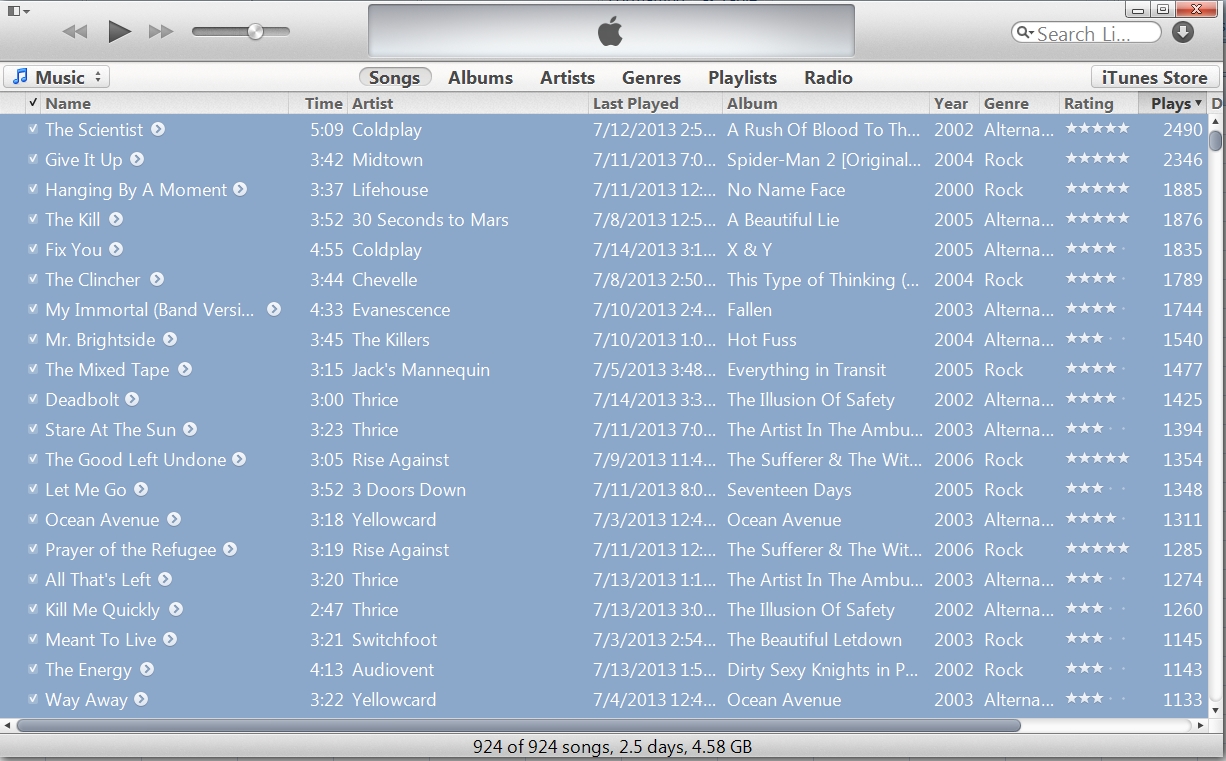
1) Open your iTunes and go to your songs tab. Make sure iTunes is showing a column for Time and Plays. (If it isn’t, you can fix this by right clicking on the columns and checking the appropriate categories.)
2) Press CTRL+A to highlight all the songs and then press CTRL+C to copy them.
3) Open Excel and press CTRL+V to paste all the information. Surprisingly, the information nicely conforms to the cells.
4) iTunes gives a lot of information superfluous to our purposes. Ignore everything but the column for Time and Plays (columns B and I for me).
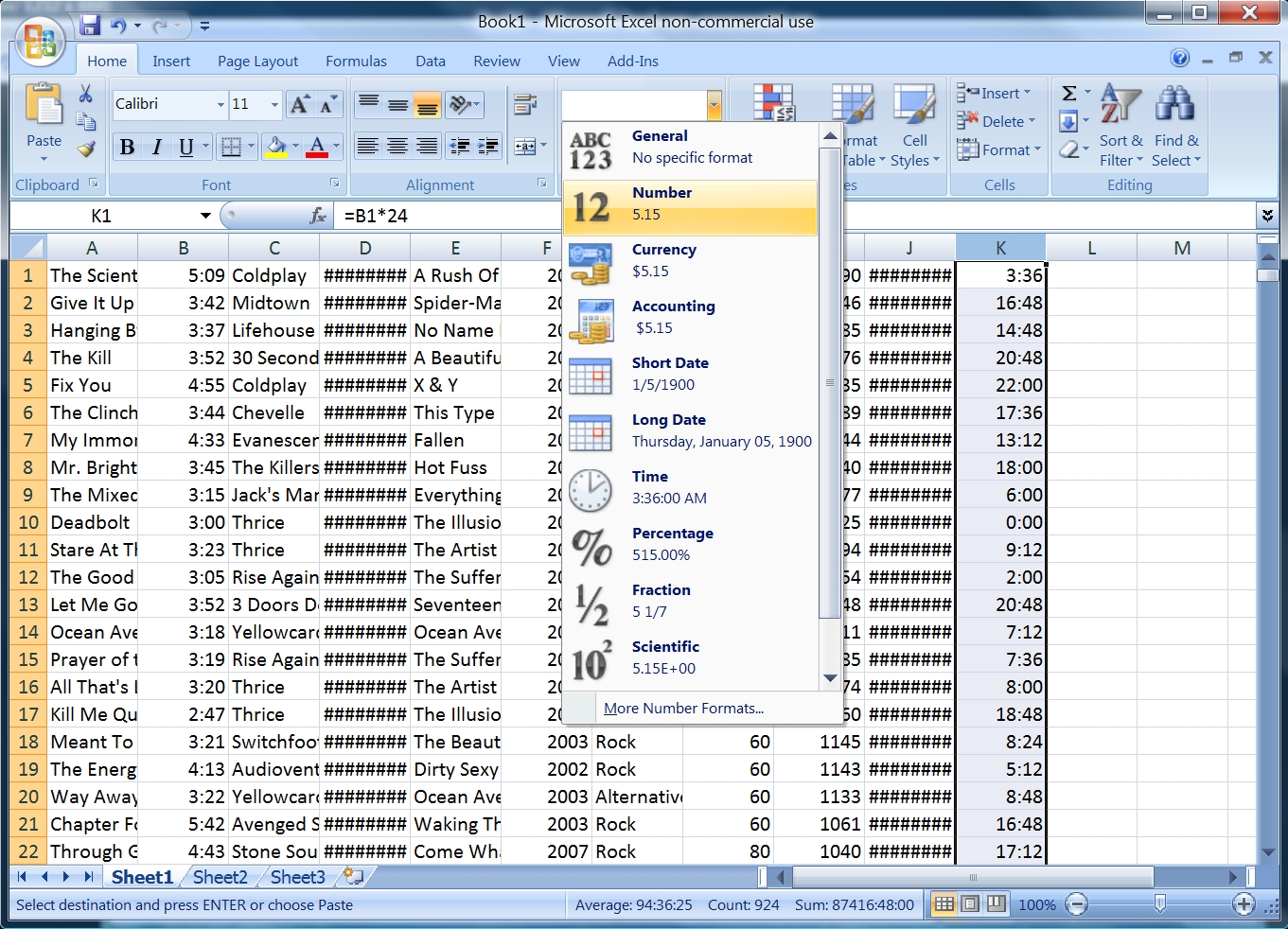
5) Create a new column by multiplying the time column by 24.
6) Highlight your new column (column K for me) and use the drop down formatting menu to convert it to a number.
You might be thinking “why on earth are we doing this?” for the last two steps. Good question. This is part is fancy, so bear with me. Excel treats the time column as a time of day rather than a number of minutes and seconds. For example, it thinks cell B1 refers to 5:09 AM, not 5 minutes, 9 seconds. Excel stores this information as a proportion of a 24 hour day. As such, it thinks of 5:09 AM as approximately 0.21458. Multiplying by 24 and converting it to a number gives us the number of minutes each song is.
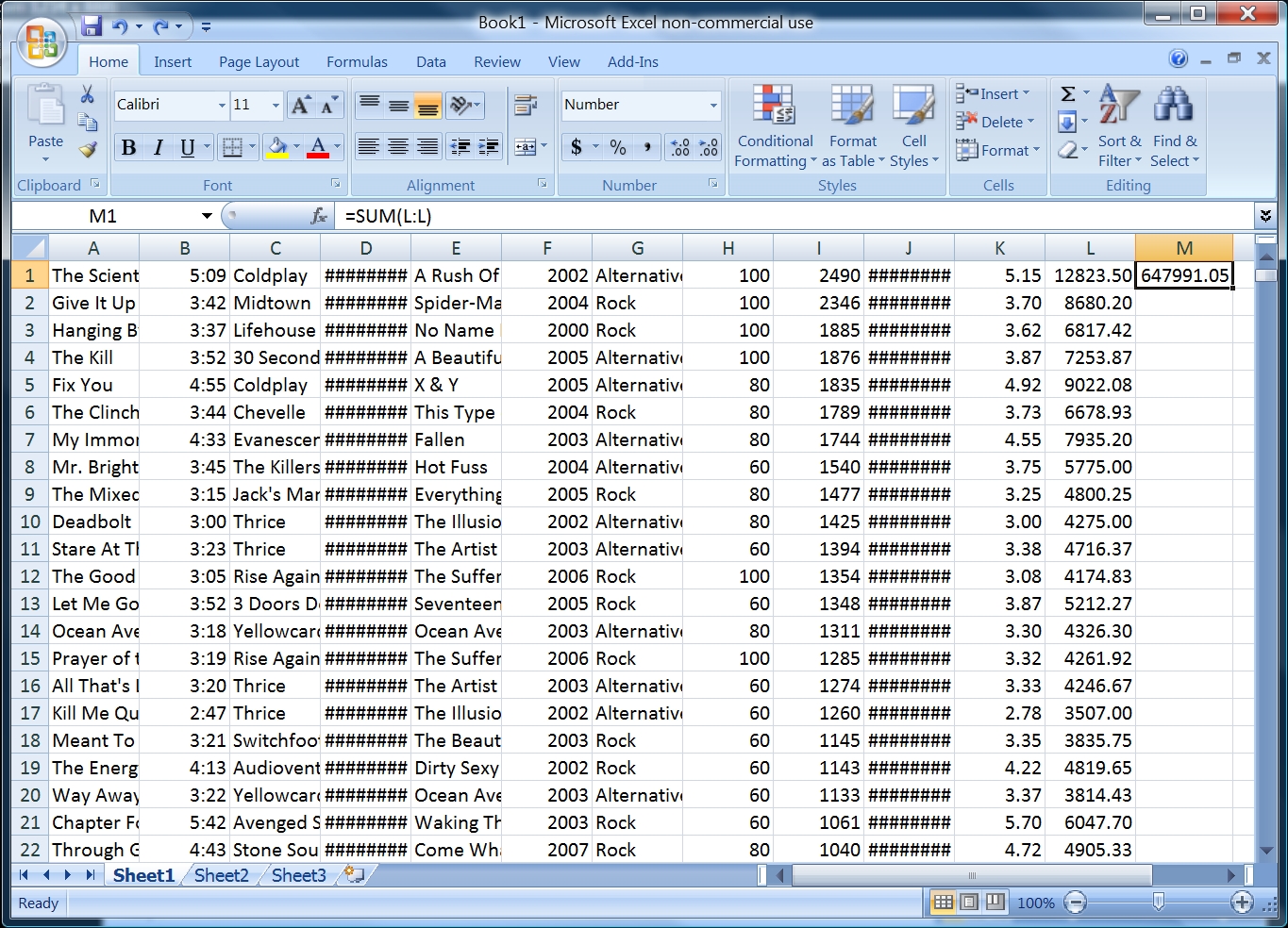
7) Create a new column by multiplying the previous new column by the Plays column. (For me, this is multiplying column I by column K.) The result is the total number of minutes you have listened to each song.
This in itself is interesting, and you can use Excel to sort the songs by the most time you have spent listening to them. This list can be quite different from your most played songs, as a 5 minute song counts for twice as much as a 2 minute 30 second song.
8) Use the SUM function to sum the column you created in step 7. This is the total number of minutes you have spent listening to iTunes.
9) Divide by 60 to get the number of hours you have spent listening to iTunes.
10) Divide step 9 by 24 to get the number of days you have spent listening to iTunes.
Can anyone top 450 days? Post your times in the comments below…
I was booking plan tickets for an upcoming trip when I discovered this hack. If you book on American Airlines’ website, it gives you the option to hold your tickets at the current price for 24 hours. Always use this option. Wait until the next day, and input your travel itinerary again. Check the price. If it is cheaper, cancel your current hold and book again for the cheaper price. Then repeat this process the next day. If the fare goes up, buy at the previous day’s price.
There is virtually no cost to doing this–the hold option is free, so the only cost is time it takes to reenter a flight itinerary–and has the potential to save you a lot of money. For example, my fare was $641 two days ago. Yesterday, it was $515. Today, it is up to $680. Consequently, I bought my tickets for yesterday’s price and saved $126. Not bad for five minutes’ effort.
(The extreme price fluctuations make no sense to me either, but that is a different discussion.)
Note that this only works if you book through aa.com. Travel aggregation websites like Kayak and Orbitz do not allow holds. Same goes for other airlines as far to my knowledge. However, if you are not committed to flying with American but American is still the cheapest option, you should still hold the tickets for 24 hours. Then, on the next day, you can rerun your search on Kayak or Orbitz and see if any of the other fares beat the one you have on hold. If so, buy from the competitor–but note that you won’t be able to hold the competitor’s price and repeat the process on the next day.
I was watching the NBA Finals last night. While the series has been good, watching professional basketball requires a certain tolerance for flopping–i.e., players pretending like they got hit by a freight train when in reality the defender barely made incidental contact. Observe LeBron James in action:
And that’s just from this postseason!
No one likes flopping, but it is not going away anytime soon. This post explains the rationality of flopping. The logic is as you might think–players flop to dupe officials into mistakenly calling fouls. There is a surprising result, however. When flopping optimally, “good” officiating becomes impossible–referees are completely helpless in deciding whether to call a foul. Worse for the integrity of the game, a flopper’s actions force referees to occasionally ignore legitimate fouls.
The Model
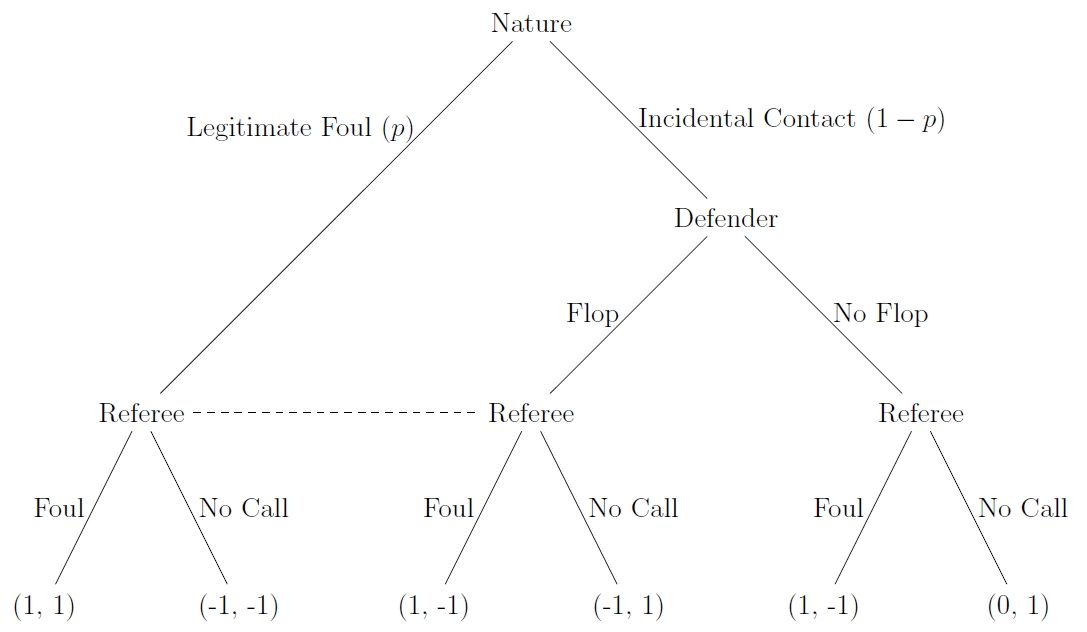
This being a blog post, let’s construct a simple model of flopping. (See figure below.) The game begins with an opponent barreling into a defender. Nature sends a noisy signal to the official whether contact was foul worthy or not. If it is truly a foul, the defender falls to the ground without a strategic decision. If it is not a foul, the player must decide whether to flop or not.
The referee makes two observations. First, he receives the noisy signal. With probability p, he believes it was a hard foul; with probability 1-p, it was not. He also observes whether the defender fell to the ground. Since the defender cannot keep standing if the offensive player commits a hard foul, the referee knows with certainty that the play was clean if the defender remains standing. However, if the player falls, the referee must make an inference whether the play was a foul.
Payoffs are as follows. The referee only cares about making the right call; he receives 1 if he is correct and -1 if he is incorrect. The player receives 1 if the referee calls a foul, 0 if he does not flop and the referee does not call a foul, and -1 if he flops and the referee does not call a foul. Put differently, the defender’s best outcome is what minimizes the offense’s chance at scoring while his worst outcome is what maximizes the offense’s chance.
(click image to enlarge)
Equilibria
Since legitimately fouled defenders have no strategic choices, we only have to solve for the non-fouled defender’s action. Therefore, throughout this proof, “defender” means a defender who was not fouled. (Rare exceptions to this will be obvious.)
We break down the parameter space into three cases:
For p = 0 Flopping does not work, since the referee knows no foul took place. This is why players don’t randomly fall to the ground when the nearest opponent is ten feet away from them.
For p > 1/2 Note the the referee will call a foul if he believes that the probability the play was a foul is greater than 1/2. Thus, if the defender flops, he knows the referee will call a foul. As such, the defender always flops, and the referee calls a foul. This is intuitive: on plays that look a lot like a foul, defenders will embellish the contact regardless of how hard they are hit.
For 0 < p < 1/2 Because mixing probabilities are messy, I will appeal to Nash’s theorem to prove that both the defender and referee mix in equilibrium. Recall that Nash’s theorem says that an equilibrium exists for all finite games. Therefore, we can show both players mix by proving that neither can play a pure strategy in equilibrium. (In other words, we expect players to sometimes flop and sometimes not to, while the referees to sometimes call a foul and sometimes not to when they aren’t sure.)
First, can the defender flop as a pure strategy? If he does, the referee’s best response would be to not call a foul, as the referee believes the probability a foul occurred is less than 1/2. But given that the referee is not calling a foul, the defender should deviate to not flopping, since he will not get the call anyway.
Second, can the defender not flop as a pure strategy? If he does, the referee’s best response is to call a foul if he observes the defender falling, as he knows that the play was a legitimate foul. But this means the defender would want to deviate to flopping, since he knows he will get the foul called. This exhausts the defender’s pure strategies, so the defender must be mixing in equilibrium.
Third, can the referee call a foul as a pure strategy? If he does, the defender’s best response is to flop. But then the referee would not want to call a foul, since his belief that the play was actually a foul is less than 1/2.
Fourth, can the referee not call a foul as a pure strategy? If he does, the defender’s best response is to not flop. But this means the referee should call a foul upon observing the defender fall, as he believes the only way this could occur is if the foul was legitimate. This exhausts the referee’s pure strategies, so the referee must mix in equilibrium.
Strategically, these parameters are the most interesting. In equilibrium, the defender sometimes bluffs (by flopping) and sometimes does not. Upon observing a fall, the referee sometimes ignores what he perceives might be a flop and sometimes makes the call.
The real loser is the legitimately fouled defender. He can’t do anything to keep himself from falling over, yet sometimes the referee does not make the call. Why? The referee can’t know for sure whether the foul was legitimate or not and must protect against floppers.
While this seems unfortunate, be glad the referees act strategically in this way–the alternative would be that defenders would always flop regardless of how incidental the contact is and the referees would always give them the benefit of the doubt.
Conclusion
One of game theory’s strengths is drawing connections between two different situations. Although this post centered on flopping in the NBA, note that the model was not specific to basketball. The interaction could have very well described other sports–particularly soccer. As long as fouls provide defenders with benefits, there will always be floppers waiting to exploit the referee’s information discrepancy.
Postscript
If I ever expand my game theory textbook to cover Bayesian games, I think I will include this one. This also makes decent fodder when random people ask “what can game theory do for us?”
This is part of an ongoing series on the profitability of MOOCs. Click below for the other entries.
Part 1: Can Free MOOCs Be Profitable?
Part 2: Can Premium MOOCs Find an Audience?
Part 3: Proven Profitability: The Freemium Vertical Integration MOOC Model
Part 4: Can We Convince People to Pay for MOOC Certificates?
Part 5: Are MOOCs Effective Advertisements?
____________
In the previous installment, I discussed the barriers to making free MOOCs profitable. To summarize, although such classes are popular, the only real way to draw in revenue is to run advertisements. Unfortunately, ad rates are abysmally low. A class might need 20,000 students to complete a course before reaching a very narrow definition of profitability.
So if MOOCs need to turn a profit, the obvious solution is to start charging for them. Even just 300 students paying $10 for a course matches the revenue 20,000 students bring in through a free course. MOOCs have such immense popularity, surely providers can convince a tiny fraction to pay a small amount of money. Right?
Don’t count on it.
Premium MOOCs face two major obstacles. First, it is not clear why anyone would want to pay money to watch online lectures. Many students take MOOCs purely as a form of entertainment, which has contributed to the abysmally low MOOC completion rates. Since 90% of enrolled students never complete a course, it is safe to assume that current registration rates will immediately drop at least 90% once providers start charging anything. And while some might find Ancient Greek Religion appealing, they might not find it to be as appealing as keeping $10 in their wallets, especially since academic courses offer little practical use to the vast majority of MOOC students.
Academic was a major caveat there. Udemy, likely the biggest name in MOOCs without any official university backing, appears to have had some success in offering applied courses. For example, look at their top premium business courses. Some of these classes have drawn in a large number of students, and the reason is obvious–paying to learn Excel is much more sensible than paying to learn the Psychology of the Mind for the average person in the workforce. Moreover, it wouldn’t be surprising if many of these “students” are actually businesses themselves, which use courses as training tools for their employees.
That said, we should take the enrollment figures with a grain of salt. This Excel basics course has more than 38,000 students, but not all of them necessarily paid the $99 price. Udemy encourages their teachers to use social media to attract students, using Reddit in particular to generate buzz. Udemy’s logic is sound–social media attention helps increase the site’s market share, and it can help a course attract good reviews to convince others to pay money. (Indeed, the Excel course has more than 400 reviews and an average rating of 4.5 out of 5.) Some teachers are raking in full-time salaries here, but this is not the massive gold mine that it might appear to be.
The second major obstacle is that it makes little sense for a consumer to purchase a course when they can take a similar course for free. Consider my Game Theory 101 MOOC. During the school year, I have about 2000 students watching my lectures per day. If I started asking for $10 per course, would the 200 people–the 10% committed to the entire course–continue using my materials? Or would they switch to the competition from Yale or Stanford/UBC? I’d like to think my introduction is the clearest of the courses, but I have no delusions that I would keep my audience. If I could get even two students a day, I’d be thrilled.
MOOC providers are aware of this problem, and they are scared. As Americans discovered the Internet, the newspaper publishing industry willingly put their material online for free. Customers liked this, canceled their physical subscriptions, and became accustomed to receiving their news for free. A decade later, newspaper publishers are having an impossible time convincing customers to pay for something they now view as unworthy of payment.
Right now, the major university-backed MOOC providers continue to push free courses to gobble up market share. Coursera and EdX might benefit if they could mutually switch over to a premium model, but they run into coordination issues and risk drawing another provider into the market pledged to keep classes free. Nevertheless, there is real hazard that the providers will eventually back themselves into a corner like the newspaper publishers, unable to find customers at a price greater than $0.
Overall, it appears that academic courses face significant obstacles to charging for their material. But if paid courses can’t bring in students and free courses bring large number of students but next to no revenue, what can work? In future posts, I will see if freemium models have any promise.
Well, it finally happened. After a year of resistance, I finally had a Doritos Locos Taco over the weekend. It pains me to say this, but they are delicious. I actually look forward to trying Doritos Locos Tacos Doritos–which, if you haven’t heard, are Doritos intended to taste like Doritos Locos Tacos.
I relayed this story last night to some URDPS folk and how I intended to create tacos using the Doritos Locos Tacos Doritos. This is when a stunning realization hit us: the Doritos Locos Tacos madness will eventually taste nothing like Doritos.
Why? Well, the chip portion of the taco only occupies the shell. This is a fixed amount of the taco as a whole. Let’s call this Doritos flavor amount p, where 0 < p < 1. Since Doritos Locos Tacos Doritos taste like Doritos Locos Tacos, they have p portion of Doritos flavor.
What happens when you construct Doritos Locos Tacos Doritos Locos Tacos? Again, the shell only takes on the flavor of chip, which is p portion. But we have diminishing Doritos returns, as that p portion only contains p portion Doritos flavor. So the Doritos Locos Tacos Doritos Locos Tacos only have p^2 Doritos flavor. And, likewise, the Doritos Locos Tacos Doritos Locos Tacos Doritos only taste like p^2 Doritos.
How about a third iteration? Again, the shell of the Doritos Locos Tacos Doritos Locos Tacos Doritos Locos Tacos only takes p of the flavor. But the original Doritos flavor only occupies p^2 portion of the Doritos Locos Tacos Doritos Locos Tacos Doritos shell. So the Doritos flavor is only p^3, and same for the corresponding Doritos Locos Tacos Doritos Locos Tacos Doritos Locos Tacos Doritos.
You can see where this is heading. The nth iteration of Doritos Locos Tacos and Doritos Locos Tacos Doritos have p^n portion of Doritos flavor. A little bit of math tells you that as the number of iteration approaches infinity, the total Doritos flavor goes to 0.
In other words, you end up with Doritos that don't taste anything like Doritos despite having n + 1 "Doritos" mentions in the name of the chip. They just taste like the inside of a Taco Bell taco.
This is the first part of an ongoing series on the profitability of MOOCs. Click below for the other entries.
Part 1: Can Free MOOCs Be Profitable? Part 2: Can Premium MOOCs Find an Audience?
Part 3: Proven Profitability: The Freemium Vertical Integration MOOC Model
Part 4: Can We Convince People to Pay for MOOC Certificates?
Part 5: Are MOOCs Effective Advertisements?
____________
It’s becoming a well known fact that MOOCs are popular but not profitable. Universities are willing to suck up the costs as a means of advertising. Charging would deter enrollment and cancel out that effect. But at some point, somebody might start wanting to make money off of the. So can MOOCs be profitable without charging a dime?
Probably not.
The only free solution is to do what network television has done for decades: run advertisements to pay the bills. The goal of this post is to convince you that this won’t work very easily.
Most of what I am about to tell you comes from first hand experience with my YouTube channel, game theory MOOC, and international relations MOOC. Consequently, I am going to make a strong assumption throughout that we will be running the hypothetical course through YouTube.
However, I also believe this is the correct thing to do–YouTube’s reach is much, much further than anything else out there. As evidence, I offer myself–a PhD candidate who has received no institutional support (in the form of class releases, publicity, or technical assistance) who has nevertheless amassed more than two million views. YouTube takes a cut of advertising revenues, but they also host the videos and find advertisers for you. One potential downside is that they limit the number of advertisements a viewer has to sit through, but I figure that no MOOC student is willing to sit through 10 minutes of commercials for every 30 minutes of lectures they watch (like TV networks do).
Okay, so our course is on YouTube. Every time an ad runs, we make a fraction of a penny–roughly 3/10ths of a penny to be more precise. Thus, we rake in $3 for every thousand viewers.
Why so low? I don’t have a good answer beyond “because that’s what the market is willing to pay.” One big issue is Adblock Plus, which allows its users to ignore the ads. YouTube’s analytics page therefore differentiates between “monetizable” and “non-monetizable” views. If Adblock Plus didn’t exist, we’d be a lot happier, perhaps increasing our revenues up to $5 per thousand. Alas, we are stuck at $3.
On the bright side, we gain another view each type someone watches one of our lectures. As such, if we have a 50 lecture class–not unreasonable since online lectures should average ten minutes–we will receive 50 views per student who finishes the course (Bear in mind that few students who “take” an MOOC actually complete it.) In turn, every thousand students yields $150.
How much does it take for a class to become profitable? Constructing an MOOC has different challenges than teaching a traditional course, but they might ultimately take the same amount of time. I hear horror stories that adjuncts work for $3000 per course, so let’s use this nightmare as a baseline. If one thousand students yields $150, we need 20,000 students to make our MOOC profitable. Browsing through Coursera enrollment rates, breaking the 20,000 barrier seems possible…until you realize that only about 10% of those people are actually completing the classes.
Now, to be fair, people who do not complete a course contribute a large number of views. (My newest incarnation of Game Theory 101 has about 14,000 views for a prisoner’s dilemma lecture but only 1400 for the final lecture.) And one Coursera class, Introduction to Artificial Intelligence, had 20,000 people complete the course. Nevertheless, you can see that reaching 20,000 students (or one million total views) is far from easy. And, again, this is only to reach a very minimum level of profitability.
Thus, free courses probably won’t ever be profitable. Nevertheless, universities remain happy to funnel money into them as a means of advertisement. A decent MOOC may very well be worth $10,000 or more in publicity. Granting course releases for faculty and hiring additional visitors to compensate more than makes up for the cost.
MOOCs have been in the news a lot recently, though most of the attention has gone toward their completion rates. At first glance, the data do not look good. It is hard to accurately measure completion rates since MOOC companies hold most of the data and are unwilling to release it for fear of negative publicity, but 10% is a good rough estimate of the average MOOC’s completion rate. This has led many to speculate that MOOCs will never truly compete with “real” college classes, since MOOCs cannot hold the attention of their students for very long.
Silliness! I don’t know what the endgame for MOOCs is. Perhaps they will radically alter higher education. Perhaps they won’t. But the 10% completion rate statistic tells you absolutely nothing about the quality of MOOC content.
In fact, I’d be perfectly fine teaching an MOOC with a 0% completion rate. To paraphrase Drew Carey, points are like MOOC completion rates. They just don’t matter.
Why? I offer three reasons:
1) “Taking” a Class Is More Like Adding a Class to Your Instant Queue
While MOOC companies do not like releasing completion rate data, they love publicizing their gaudy enrollment rates. One component of completion rates is enrollment rates, since you calculate it by dividing the number of individuals who completed the class by the number enrolled.
The problem is that “taking” a class is not taking a class. To use a Netflix analogy, enrolling in an MOOC is not watching a movie–it is putting said movie into your instant queue. Whether you ever end up watching that movie remains in doubt. Drive sat in my instant queue for a year and a half before I finally watched it a couple weeks ago, while True Grit has stayed in there since the beginning of time.
So, really, MOOC enrollment is a type of bookmark. People learn about a course through the interwebs and “enroll” in it to save it for later. To wit, my Udemy game theory and international relations courses went viral yesterday, but only a few of the new additions have watched any of the lectures.
Is this a problem? No. The real issue is that people do not understand that online enrollment is different from physical enrollment. Physical enrollment numbers will always be smaller, since only the super-interested will pay the hundreds or thousands of dollars to enroll in a class. MOOC enrollment will always be higher because signing up is free but only signals a passing interest in the material.
2) MOOCs Are Educational Entertainment
Undergraduates usually enroll in classes because they find the topic interesting. MOOC users start watching videos for the same reason. But think back to your undergraduate career. How many classes did you lose interest in after eight weeks? Probably a lot. In the real world, however, you stuck it out–the alternative was failing the class. But in MOOC world, you are free to walk away. So this means a student who has gone through 80% of the material still goes down as an incomplete.
Personally, I don’t blame the students. After eight weeks of teaching a course, I often get bored and wish I was doing something else as well.
College classes have to run a certain number of weeks to fulfill university requirements regardless of how many weeks of material are actually useful from the professor’s perspective. For now, a lot of MOOC syllabi are copy/paste jobs from the real world. This will eventually change as MOOCs become their own type of course. But even then, what a professor finds interesting for eight weeks, another person would only find interesting for five. But I’d rather have that student watch five weeks worth of lectures to watching none of them, completion rate be damned.
3) MOOCs Are Supplements to Real Courses
If MOOCs have done nothing else, they have proven to be an effective alternative to a terribly unclear professor. We have all had one of these teachers at one point in our life. It makes the college experience miserable. Before, there wasn’t much you could do about it. Today, you can hop online, find the corresponding class, and watch someone who is good at teaching explain the material.
These people won’t be counted as having completed the MOOC. But the MOOC still served its purpose.
The Takeaway
While completion rates matter in real life, they don’t really matter in MOOC world. They are apples and oranges, and caring about MOOC completion is an utter waste of time.
Instead, we really should be caring about how many views our lectures receive. Views actually measure interest and usefulness of any particular lecture. And, unlike enrollment figures, they actually indicate commitment to learning.
Oh, and views can be monetized. But that’s a topic for another post.
Apparently the World Baseball Classic will compensate Major League Baseball teams if an injured WBC player misses 30 days or more of the regular season. But if the player misses less than that? No compensation.
So. Imagine your $10 million player breaks a finger and is out for four weeks. He’s ready to come back on the 28th day. As a general manager, do you:
Take him off the disabled list immediately and receive no compensation.
Wait two days, take him off after the 30th day, and receive about $1.7 in compensation.
Option #2 looks very tempting.
Will the perverse incentives come into play this year? Unlikely, but it is possible. Mark Teixeira and Hanley Ramirez are both out for eight weeks, long enough to guarantee they will be compensated for. Brett Lawrie could push it, though. He’s on the DL with a cracked rib. However, his salary is a measly $500,000 this season, and last season’s production well exceeded a half million dollar contract. If Lawrie were ready to return after 28 days, the Blue Jays would essentially pay a $120,000 premium–$60,000 per game–to do so. This is roughly equivalent to a player worth $11 million. It would be a close call.



 William Spaniel